
A rechargeable LED searchlight works by directing a high-intensity LED light source through a precision optical lens system that concentrates the beam into a tight, long-range projection. The LED is powered by a lithium-ion battery pack, which delivers consistent voltage throughout the discharge cycle to maintain stable output. The result is a portable, self-contained light source capable of projecting a usable beam over hundreds of metres without any external power supply.
This guide explains the technology behind modern rechargeable LED searchlights – how the optics work, what determines beam distance, how different beam types behave, and what the specifications actually mean when you are choosing between models.
What Is a Searchlight?
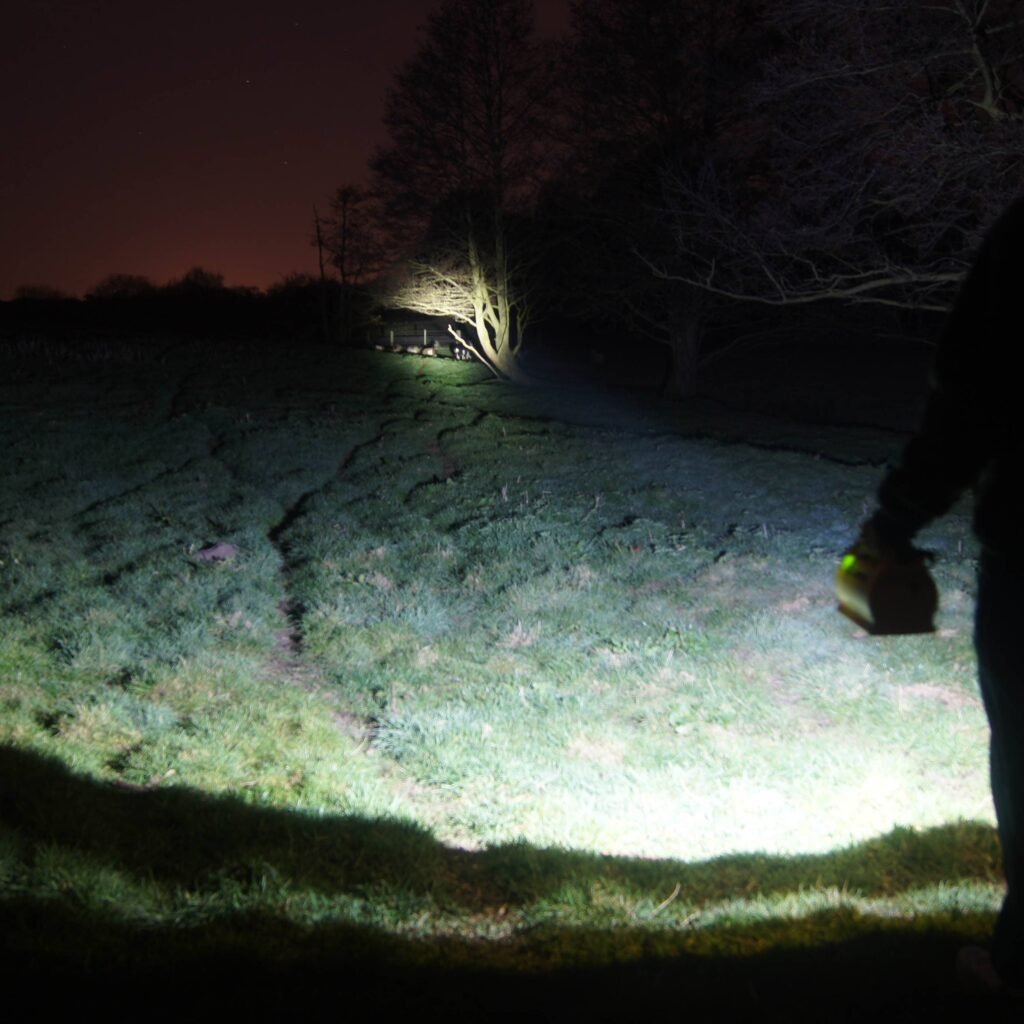
A searchlight is a high-output directional light designed to project a concentrated beam over long distances. Unlike a floodlight, which spreads light broadly across a nearby area, a searchlight focuses its output into a narrow, intense beam that carries intensity over distance.
Professional rechargeable LED searchlights are portable, battery-powered units used in security, search and rescue, maritime operations, railway inspection, emergency response, and any application requiring long-range visibility without power infrastructure.
The key difference between a searchlight and any other portable light is beam concentration. That concentration is what creates reach – and understanding how it works explains why two lights with similar lumen ratings can perform very differently at range.
How LED Light Sources Work in Searchlights
LED stands for Light Emitting Diode. Unlike traditional bulb-based light sources, an LED produces light through a semiconductor process rather than heating a filament or exciting a gas. This produces several characteristics that make LEDs the dominant technology in professional searchlights.
Instant full output. LEDs reach their rated brightness the moment they are switched on. There is no warm-up period.
High luminous efficiency. LEDs convert a significantly higher proportion of electrical energy into light rather than heat compared to halogen or HID alternatives. This means more usable lumens per unit of battery capacity – directly extending runtime.
Long operational life. Quality LED arrays last tens of thousands of hours before significant output degradation. A professional searchlight built around a quality LED is not a consumable in the way older bulb-based units were.
No fragile components. LED solid-state construction has no filament to break, no gas to leak, and no glass envelope to shatter. For field use where equipment gets knocked around, this resilience is directly practical.
In a searchlight specifically, the LED array sits at the focal point of the optical system. The quality and precision of that pairing determines how effectively the raw lumen output is converted into usable beam intensity at range.
The Optics: How a Beam Is Formed
Raw lumens from an LED array radiate in multiple directions. A searchlight’s optical system gathers that output and directs it into a controlled beam. Two primary optical approaches are used in professional searchlight design.
Reflector systems position the LED at the focal point of a parabolic reflector dish. Light radiating outward from the LED bounces off the reflector surface and exits as a parallel beam. The larger and more precisely shaped the reflector, the more tightly it collimates the beam – and the further the beam carries usable intensity.
Lens systems use a precision lens (typically a Fresnel or condenser lens configuration) positioned in front of the LED to bend light rays into a controlled output pattern. Lens systems allow more precise beam shaping and are used where adjustable beam patterns (from spot to flood) are needed in a single unit.
Many professional searchlights combine both. A reflector provides primary beam formation, with a lens element providing adjustment capability.
The optical quality of these components matters as much as LED output. A high-quality optical system on a moderate LED outperforms a poor optical system on a higher-rated LED. This is why two searchlights with similar lumen specifications can behave very differently in real-world use.
Lumens vs Beam Distance: Understanding the Difference
This is the most commonly misunderstood aspect of searchlight specification, and it is worth getting right before comparing products.
Lumens measure total light output – the sum of all light emitted by the source in all directions. Two searchlights with the same lumen rating can have completely different beam distances if one has a tighter, more focused beam than the other.
Beam distance (measured in metres) measures how far the beam carries before it falls below a threshold that is considered useful. It is a product of optical concentration, not raw lumen output.
A 1000 lumen searchlight with tight precision optics will outreach a 3000 lumen floodlight at distance every time. The floodlight disperses its higher output across a wide area. The searchlight concentrates its lower output into a narrow beam that retains intensity at range.
This is why lumen count alone is the wrong metric for evaluating a searchlight. Beam distance at useful intensity is what matters.
| Metric | What It Measures | What It Tells You |
|---|---|---|
| Lumens | Total light output in all directions | Overall brightness of the source |
| Candela | Light intensity in a specific direction | Beam intensity at the point of focus |
| Beam distance (metres) | Range before beam drops below useful threshold | Real-world reach in the field |
| Beam angle (degrees) | Width of the beam pattern | Coverage area vs throw distance trade-off |
When evaluating searchlight specifications, beam distance and candela are more meaningful than lumens for understanding how a unit will perform at range.
How Far Can a Rechargeable LED Searchlight Beam Reach?
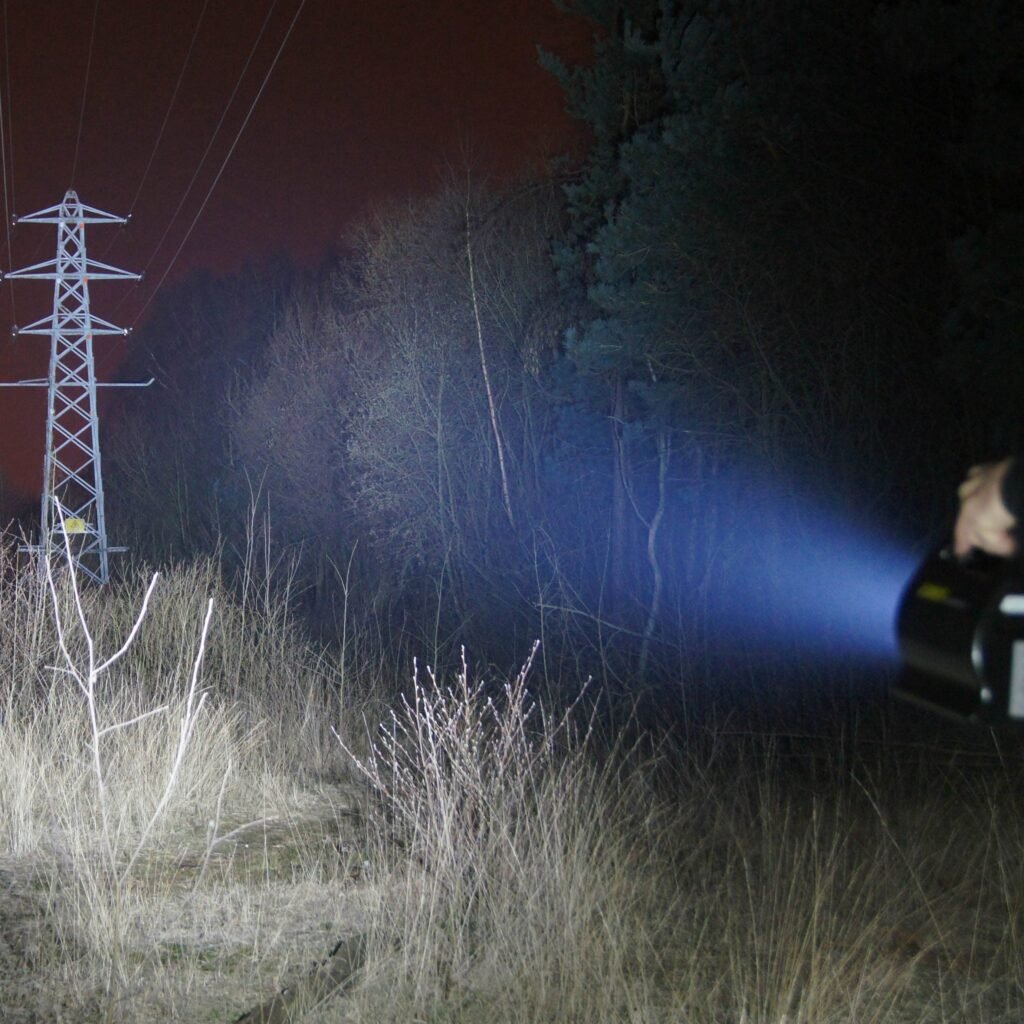
A professional rechargeable LED searchlight beam typically reaches between 500 and 1,300 metres at useful intensity, depending on beam type, optical quality, and output level. Spot beam configurations at maximum output achieve the greatest distance. Flood or wide beam modes sacrifice distance for coverage.
Factors that affect real-world beam reach:
Beam type. A tight spot beam concentrates output into the smallest possible angle, maximising range. A wider beam spreads the same output across a larger area, reducing intensity at any given distance but improving nearby coverage.
Atmospheric conditions. Fog, rain, mist, and dust scatter light. Beam reach in poor conditions can be significantly lower than in clear air. This is relevant for marine, outdoor winter, and incident-scene use where conditions cannot be controlled.
Output level. Most professional searchlights offer multiple brightness settings. Beam distance at maximum output is higher than at reduced settings, but runtime at maximum output is shorter. Finding the right balance for your application is a practical decision, not just a specification comparison.
Optical quality. As covered above, the precision and quality of the reflector or lens system directly affects how tightly the beam is formed and how far it carries useful intensity.
Spot Beam vs Flood Beam in Searchlights
Most professional rechargeable searchlights offer either a fixed beam pattern or adjustable capability between spot and flood. Understanding what each delivers helps match the unit to the application.
Spot beam concentrates the full output into the tightest possible angle. Maximum range, minimum spread. Ideal for identifying specific objects at distance – checking a fence line, assessing terrain ahead, scanning water surfaces, or signalling over distance.
Flood beam in a searchlight context does not mean the broad spread of an area floodlight. It means a wider beam angle than the spot mode (perhaps 15 to 30 degrees rather than 3 to 8 degrees) providing more coverage of a nearby area at the cost of long-range reach.
Adjustable beam units switch between these modes and often cover intermediate positions. The practical advantage is versatility – sweep a large area in flood mode to locate a target, then switch to spot to illuminate it clearly at distance.
The SL850LiF features adjustable beam capability, moving from tight spot for distance work to wider flood for closer scene coverage. For applications where both are needed across a single deployment, this eliminates the need to carry separate units.
Lithium-Ion Battery Technology and Power Delivery
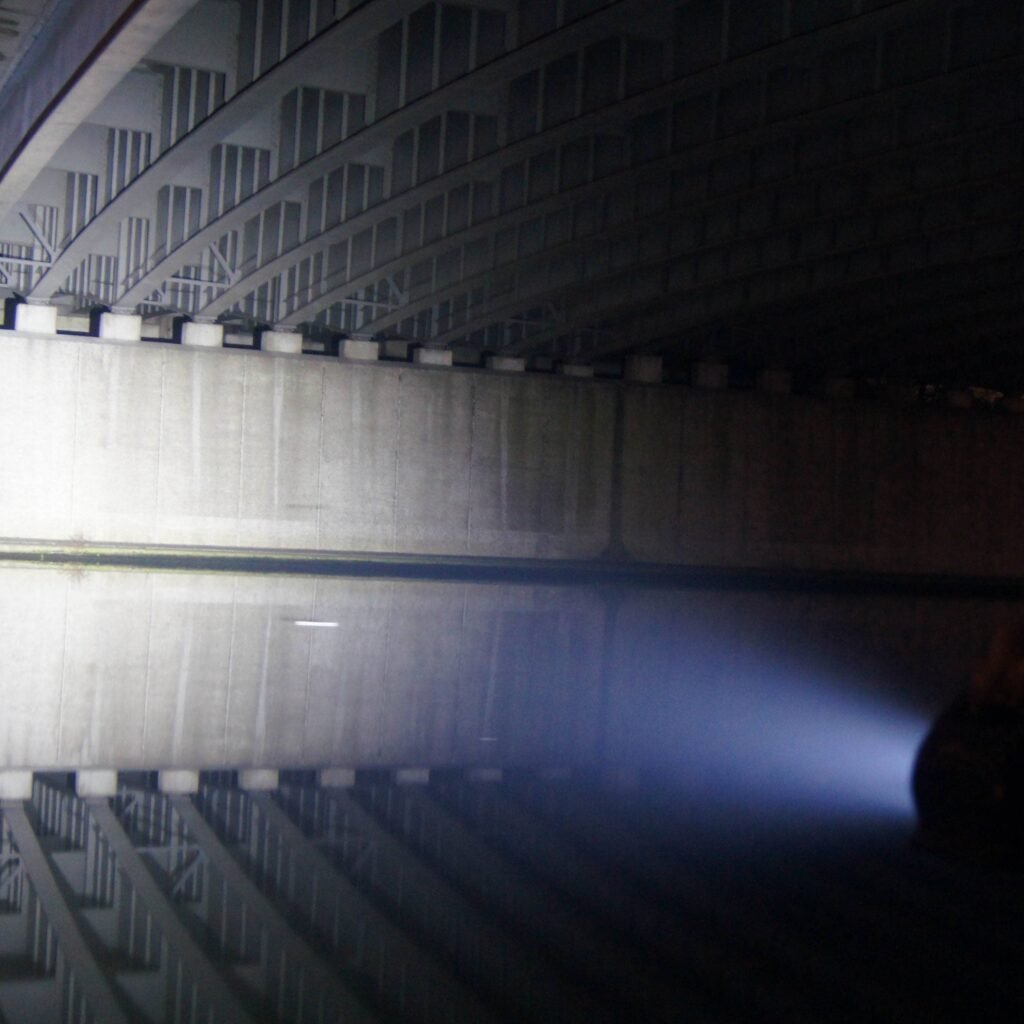
The battery system in a rechargeable LED searchlight determines runtime, consistent output across the discharge cycle, and long-term reliability.
Why lithium-ion is the correct technology for professional searchlights:
Lithium-ion cells have the highest energy density of any rechargeable battery chemistry in commercial use. More energy per unit of weight and volume means more runtime without making the unit impractically heavy for field carry.
Critically, lithium-ion cells maintain relatively stable voltage throughout most of the discharge cycle. This matters for searchlight performance because LED output is voltage-dependent. A battery that delivers stable voltage means the beam maintains consistent brightness rather than dimming progressively as the battery depletes.
Older NiMH battery chemistry suffers from pronounced voltage sag – the battery weakens steadily from full charge, and the beam dims visibly across the deployment. A quality lithium-ion powered searchlight holds its output level until the battery approaches depletion, then drops off quickly rather than degrading slowly.
Battery management systems (BMS) in professional units regulate charge and discharge to protect cell longevity. They prevent overcharging, manage discharge depth, and balance cells in multi-cell packs. A BMS extends battery life across hundreds of cycles and is a standard feature in professionally specified equipment.
Charging: Modern professional searchlights charge via USB-C, compatible with standard charging infrastructure at depots, in vehicles, and via power banks in the field. This eliminates the bespoke charger management that older proprietary charging systems required.
IP65 Weatherproofing: Why It Matters for Searchlight Use
A searchlight without weatherproofing is a fair-weather tool. Professional use (security, emergency response, maritime, railway) happens in all conditions. The IP rating confirms that the unit is built for it.
IP65 means:
- 6 (dust) – completely dust tight. No ingress under any conditions.
- 5 (water) – protected against water jets from any direction.
For outdoor professional use in the UK, IP65 covers rain, splashing, dusty environments, and the incidental exposure that field use inevitably involves. The unit can be carried in the rain, used in marine spray conditions, and wiped down without concern for water ingress into the electronics or battery housing.
The LED and optical assembly in an IP65-rated searchlight are sealed from the environment. This matters specifically for long-term reliability – moisture ingress into an LED assembly degrades output over time and eventually causes failure. A properly IP65-rated unit maintains performance across years of outdoor use.
The Samalite Searchlight Range: Technology in Practice
Samalite’s rechargeable searchlight range applies this technology across three models suited to different professional requirements.
SL2000Li – Maximum Output and Beam Distance
The SL2000Li is the highest-output unit in the Samalite range. Built for applications where maximum beam throw is the primary requirement – security perimeter checks across large sites, search and rescue in open terrain, maritime use, and emergency scene assessment on arrival.
The SL2000Li prioritises long-range spot beam performance. For teams whose primary need is seeing as far as possible, this is the correct specification.
SL850LiF – Adjustable Beam for Versatile Professional Use
The SL850LiF offers variable beam adjustment from tight spot to wider flood. This versatility suits applications where both range and coverage are needed across a single deployment – emergency response teams assessing a scene then moving into close work, inspection teams covering both distance and nearby detail, or security operatives sweeping large areas before focusing on specific targets.
The spot-to-flood adjustment is the defining specification advantage of the SL850LiF for multi-task professional use.
SL850LiS – Compact and Portable
The SL850LiS delivers the core SL850 performance in a format optimised for portability and ease of carry. For teams where weight and packability are important alongside searchlight capability, the SL850LiS provides the essential performance without the bulk of larger units.
View the full Samalite searchlight range for a direct specification comparison across all three models.
Frequently Asked Questions
A searchlight projects a concentrated, long-range beam designed to illuminate objects at distance. A floodlight spreads light broadly across a nearby area. The difference is optical concentration – a searchlight’s lens or reflector system focuses its output into a tight beam that retains intensity at range, while a floodlight disperses its output for wide coverage close to the unit. The two serve different purposes and are often used together in professional lighting kits.
A rechargeable LED searchlight uses a high-intensity LED positioned at the focal point of a precision reflector or lens system. The optics concentrate the LED output into a narrow, directed beam. A lithium-ion battery pack powers the LED, delivering stable voltage to maintain consistent output across the discharge cycle. The sealed housing carries an IP rating that protects the electronics and optics from dust and water in outdoor field use.
A professional rechargeable LED searchlight typically projects a usable beam between 500 and 1,300 metres depending on beam type, optical quality, output level, and atmospheric conditions. Tight spot beam configurations at maximum output achieve the greatest range. Wider beam modes and reduced output settings sacrifice distance for coverage or runtime. Fog, rain, and dust reduce effective range in poor conditions.
Lumens measure total light output in all directions. Beam distance measures how far the beam carries useful intensity in the field. A searchlight with modest lumen output but precision optics can outreach a higher-lumen light with less focused optics. For evaluating searchlight performance, beam distance and candela (directional beam intensity) are more meaningful specifications than lumens alone.
Lithium-ion cells offer the highest energy density of any commercial rechargeable chemistry, delivering more runtime per unit of weight. They also maintain stable voltage through most of the discharge cycle, which keeps LED output consistent rather than fading as the battery depletes. A battery management system in professional units protects cell longevity across hundreds of charge cycles.
IP65 means the unit is completely protected against dust ingress and resistant to water jets from any direction. For outdoor professional use in conditions involving rain, spray, dust, and general field exposure, IP65 is the minimum rating worth specifying. It ensures the sealed LED assembly and electronics remain protected across years of outdoor deployment.
The SL2000Li delivers maximum output and beam throw, prioritising long-range spot beam performance for applications where reach is the primary requirement. The SL850LiF features adjustable beam capability from spot to flood, making it the more versatile choice for applications where both range and coverage are needed across a single deployment. See the full searchlight range for a direct comparison.