
A building site goes through several distinct phases before completion. Groundworks. Structural frame. Weathertight shell. First and second fix. Finishing. Each phase has different lighting requirements, different available power infrastructure, and different working conditions.
The challenge for site managers and contractors is that lighting needs to adapt to all of these phases – often without the fixed power infrastructure that would make conventional lighting straightforward. Rechargeable portable LED lighting addresses this directly. It works from day one on a groundworks-only site with no power supply, and continues to perform through every subsequent phase regardless of where the mains supply is at any given point in the project.
This guide covers what construction site lighting actually needs to deliver across each phase of a build, the specifications that matter for professional site use, and how to build a practical lighting setup for different scales of project.
Why Construction Lighting Is a Different Problem
General-purpose portable lighting works well enough in stable environments. Construction sites are not stable environments.
The work area changes every day. Power availability shifts as the project progresses. Teams move between locations within a single shift. Outdoor exposure, dust, concrete, and wet conditions are constant factors rather than occasional ones. And in the UK, dark starts and early finishes cover five months of every working year.
This combination of factors rules out most consumer-grade and semi-professional lighting. Equipment that cannot handle daily exposure to the conditions of a working building site will not last a season, let alone a project that runs twelve to eighteen months.
Construction site lighting needs to be:
- Operational from day one, regardless of power supply status on site
- Durable enough for daily use in physically demanding conditions
- Redeployable as work areas move through a shift and across a project
- Adequate for the HSE requirements for site illumination
- Available in formats that cover everything from individual task work to large open areas
Site Lighting Requirements Under HSE Guidelines
The Health and Safety Executive requires that construction sites provide adequate lighting for work to be carried out safely. Where natural light is insufficient, artificial lighting must be provided.
For most site tasks, a minimum of 50 lux is required for general movement and low-detail work. Work requiring moderate detail (most construction tasks) typically needs 100 to 200 lux. Tasks requiring fine detail or colour differentiation need 300 lux and above.
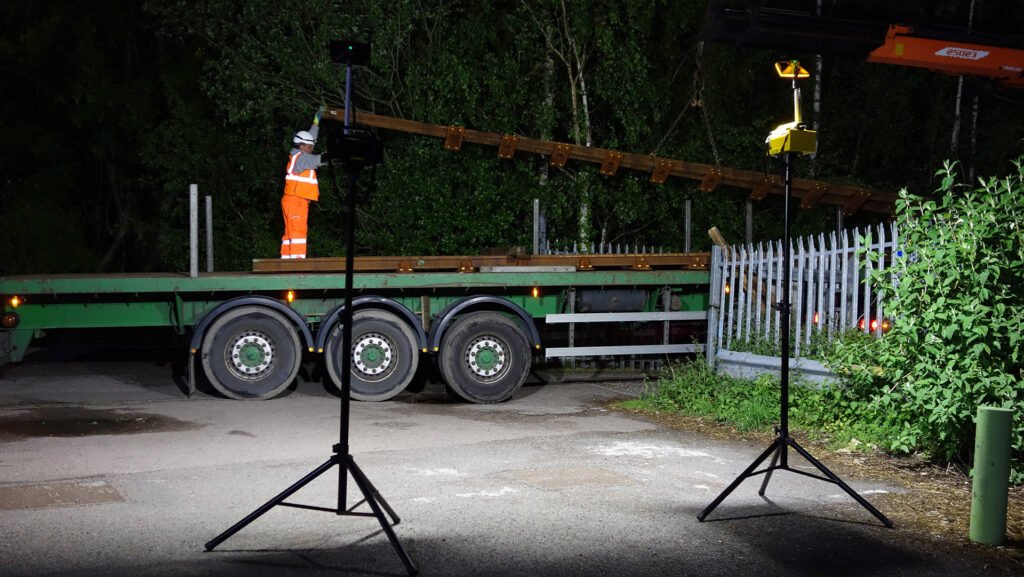
Portable rechargeable floodlights providing 2,000 to 14,000 lumens, positioned correctly for the work area, meet these requirements across the full range of typical construction tasks. The key is positioning – a single high-output unit pointed from one angle creates shadows that reduce effective lux at the work surface. Multiple units from different positions eliminate this problem.
Site managers specifying lighting should document their lighting provision as part of site welfare planning, particularly for projects running night shifts or significant winter working hours.
Lighting Needs by Construction Phase
Groundworks and Enabling Works
The earliest phase of most projects offers the least infrastructure. No mains supply on site. No welfare facilities. Often no site compound. Just the work and whatever the team brings with them.
Rechargeable portable lighting is the only practical solution at this stage. Excavations, drainage runs, utility diversions, and pile driving all happen in terrain that changes daily. Lights need to follow the work without any infrastructure dependency.
The Ultralight range suits groundworks teams well – high output in a lightweight, portable format that travels in a standard works van and deploys without specialist handling. The Eco-Flood range covers larger task areas where more output is needed from a single unit.
For large excavations, drainage trenches, or earthworks covering significant areas, the ALU area lighting range provides elevated illumination from telescopic masts – reducing the total number of units needed to cover a large open work zone.
Structural Frame
Once the structure begins to rise, the lighting challenge changes. Work moves vertically as well as horizontally. Scaffolding creates platforms at multiple levels. Interior spaces begin to form before windows and roof coverings are in place.
At this stage, portable rechargeable floodlights serve two distinct roles: general area illumination at ground level for plant operators and materials handling, and task lighting at elevation for structural trades working on frame and floor connections.
Compact portable units carried onto scaffolding by individuals (rather than large area systems requiring two people to move) are the practical choice at height. The Eco-Flood range provides the output needed for structural work in a format that one person can safely carry and position on a scaffold platform.
Rechargeable head torches become increasingly important at this phase for individual trades working in partially enclosed or elevated positions where both hands need to be free.
Weathertight Shell and Roof
Roofing and cladding work, window installation, and making the building weathertight all happen at height and in exposed conditions. Wind, rain, and cold temperatures are routine rather than exceptional.
IP65-rated lighting is non-negotiable at this phase. Equipment that is not properly rated will fail (not occasionally, but regularly) when exposed to the British weather across a winter programme.
The thermal performance of lithium-ion batteries in cold conditions is also relevant at this phase. Below 5 degrees, battery capacity reduces measurably. Below 0 degrees, runtime can drop by 20 to 30 percent from rated figures. Build this into runtime planning for any project with significant winter working at this phase.
First Fix: Mechanical and Electrical
The first fix phase is where the full range of lighting requirements converges on a single project simultaneously. Electricians need close, even flood beam illumination for cable routes, containment, and initial connections. Plumbers need task lighting in plant rooms, roof spaces, and floor voids. Structural trades continue working in partially complete areas.
This is typically the phase where site power becomes more established, but many areas of a large building remain without local power supply throughout first fix. The ability to deploy a rechargeable floodlight in a plant room on the top floor without running an extension from the temporary supply board on the ground floor is a genuine operational advantage.
For electricians specifically, a flood-beam rechargeable head torch is the most effective personal lighting tool during this phase. The HL600F provides even flood beam illumination at 3,600 lumens with both hands free – suited directly to containment installation, cable pulling, and panel connection work.
Second Fix and Finishing
The final phases of construction involve the greatest variety of trades working simultaneously in close proximity. Joiners, decorators, tilers, electricians completing connections, plumbing finishing, mechanical commissioning – all in the same building, often in the same areas.
At this stage, the lighting requirement shifts toward quality of illumination rather than just quantity. For snag checking and finishing work, accurate colour rendering allows defects in paintwork, tiling grout, and surface finishes to be identified clearly. A CRI (Colour Rendering Index) of 80 or above is worth specifying for lighting used during finishing and inspection work.
Portable rechargeable floodlights with good CRI performance ensure snag lists reflect actual defects rather than the distortion of poor-quality light. For principal contractors managing project handover, this is a practical quality control consideration as much as a lighting one.
Outdoor vs Indoor Site Lighting Requirements
Construction sites span both environments simultaneously, and the requirements differ enough to warrant separate consideration.
| Factor | Outdoor Areas | Indoor/Enclosed Areas |
|---|---|---|
| IP rating required | IP65 minimum | IP44 minimum, IP65 preferred |
| Weather exposure | Rain, wind, dust, temperature variation | Limited – but wet trades create moisture |
| Emission concern | None | Generator lighting not appropriate |
| Light dispersal | Wide beam for open areas | Focused units – reflective surfaces amplify |
| Wind stability | Tripod weighting or anchoring needed | Less critical indoors |
| Output needed | Higher – ambient light competes outdoors | Lower – enclosed spaces concentrate output |
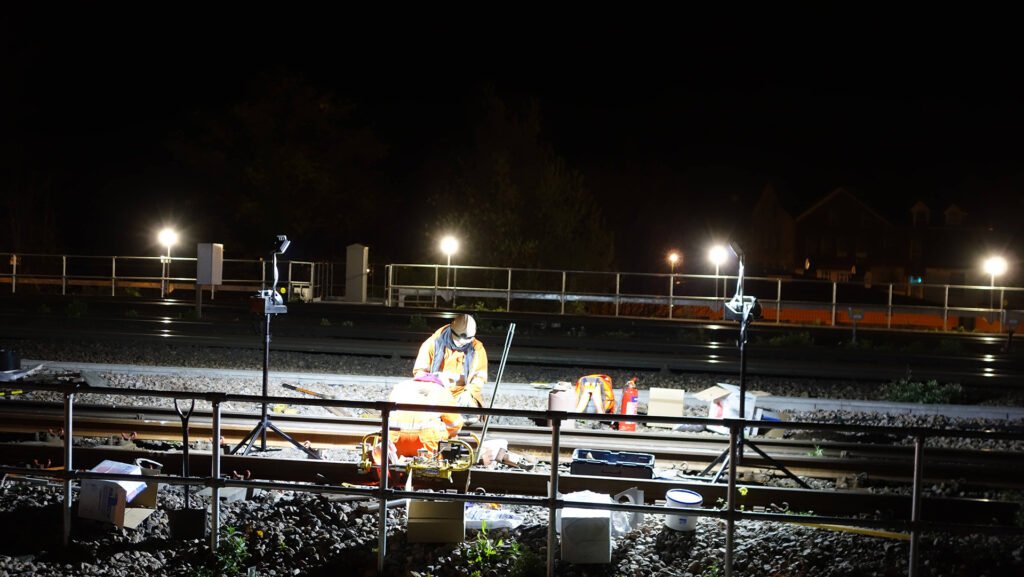
For indoor areas without ventilation, including basements, enclosed ground floors before windows are installed, and plant rooms, battery-powered lighting is the only appropriate choice. Generator lighting in poorly ventilated spaces creates carbon monoxide accumulation that poses a serious health risk.
Building a Site Lighting Setup by Project Scale
Small Residential Build or Single Trade Contractor
For a single house build or a single trade working across a residential project, a compact, practical kit covers the full requirement without over-specifying.
Recommended starting setup:
- 2x compact rechargeable floodlights with stands (general task lighting)
- 1x rechargeable head torch per operative (hands-free personal lighting)
- Charging at the site compound or at home overnight
The Eco-Flood range and HL1300W head torch cover this scale of project effectively.
Medium Commercial or Multi-Trade Site
A medium commercial project with multiple trades working simultaneously needs more units and more output coverage.
Recommended starting setup:
- 4 to 6x compact rechargeable floodlights for task areas
- 1 to 2x ALU area lighting units for large open zones
- Rechargeable head torches for all operatives
- Designated charging location in the site compound
The ALU2000Li and ALU4000Li handle the large area requirements. Compact units from the Eco-Flood range cover individual trade task areas.
Large Principal Contractor or Night Shift Operation
Large sites running night shifts or major winter programmes need fleet-level lighting management rather than individual unit procurement.
Key considerations at this scale:
- Standardise equipment across the fleet for interchangeable deployment and simplified charging infrastructure
- Size the fleet to cover concurrent lighting demand across all active areas, plus reserves for rotation
- Establish charging stations in multiple locations across a large site rather than a single central point
- Plan for the HD200 Power and Lighting range where operatives need both a power output for tools and site lighting from a single deployable unit in remote areas of a large site
Practical Deployment Considerations for Site Managers
Tripod stability on uneven ground. Construction sites are rarely level. Tripod-mounted floodlights on uneven or soft ground need checking before leaving lights unattended. A light that falls over mid-shift creates both a safety hazard and a work interruption. Use tripod spreaders or weighting where ground conditions require it.
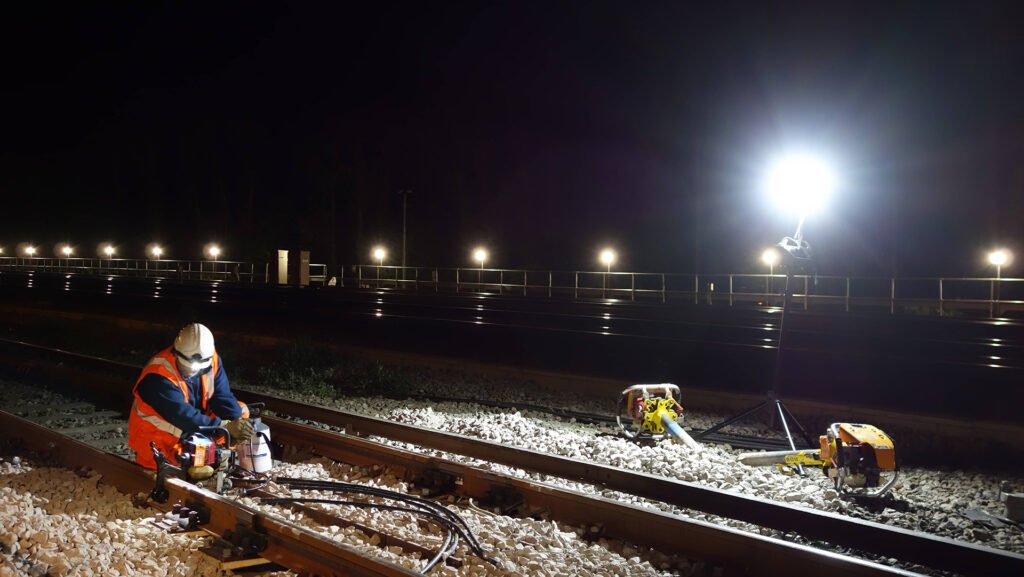
Positioning for shadow elimination. The most common mistake in site lighting is relying on a single high-output unit. Two units at 2,000 lumens positioned from opposite sides of a work area deliver better usable illumination than one unit at 4,000 lumens from a single position. Shadows from the second source eliminate shadows from the first.
Charging discipline across a team. Lights that have not been charged are not available for the next shift. Assign responsibility for charging clearly, establish designated charging points in the compound, and make post-shift charging part of site closedown procedure rather than an afterthought.
Equipment security on site. Portable, valuable equipment on a construction site is a theft target. Develop a collection and storage procedure that brings lighting equipment in with other tools at the end of each shift.
Rechargeable vs Generator: The Construction Site Decision
The broader comparison between rechargeable and generator-powered site lighting has been covered in detail elsewhere. For construction sites specifically, the decision often comes down to project phase rather than a permanent choice between the two approaches.
Early phases with no power supply favour rechargeable lighting entirely. Later phases with established site power may see generator or mains-connected area lighting for the largest work zones, with rechargeable portable units continuing to serve individual task areas and locations away from the main supply.
For most trades and site managers, rechargeable portable lighting covers the full requirement throughout the project. The minority of situations where generator power genuinely offers an advantage (very large open areas requiring sustained multi-shift illumination from a fixed position) are the exception rather than the rule on most building projects.
Frequently Asked Questions
The HSE requires adequate lighting for safe working on construction sites. In practice this means a minimum of 50 lux for general movement and access routes, 100 to 200 lux for most construction tasks, and 300 lux or above for detail work and inspection. Portable rechargeable LED floodlights providing 2,000 to 14,000 lumens meet these requirements across all typical construction tasks when positioned correctly. Site managers should document lighting provision as part of welfare planning, particularly for projects with significant dark-hours working.
The most practical setup for most construction sites combines area lighting units for large open zones with compact portable floodlights for task-specific areas, and rechargeable head torches for individual operatives. The ALU area lighting range provides elevated high-output illumination from fewer units. The Eco-Flood range covers portable task lighting. Head torches from the Samalite range provide hands-free personal lighting. The right combination depends on project scale and phase.
Yes. IP65-rated rechargeable floodlights handle rain, wind, and cold temperatures reliably. The main winter consideration is battery performance – lithium-ion cells deliver reduced capacity in cold conditions, potentially reducing runtime by 20 to 30 percent at temperatures near or below freezing. Build this margin into runtime planning for winter outdoor working and charge equipment fully before each shift.
Runtime depends on the model and output level used. Professional units typically deliver 4 to 10 hours at working brightness. For a standard shift, units should be fully charged at the start of each working day. For night shifts or extended operations, carry spare charged units or plan for mid-shift charging at the site compound. Always verify runtime at the output level you will use – maximum quoted runtime figures are measured at minimum brightness.
Outdoor areas need IP65-rated equipment at minimum and benefit from higher output to compensate for the absence of reflective surfaces that amplify light indoors. Indoor areas can use slightly lower output because light bounces off walls, floors, and ceilings to provide more even distribution than outdoor equivalent output would. In enclosed indoor areas without ventilation, battery-powered lighting is the only appropriate choice – generator lighting in poorly ventilated spaces creates carbon monoxide accumulation that poses a serious health risk.
It depends on the size and phase of the project. For a small residential build, two to four compact floodlights plus individual head torches cover the typical requirement. For a medium commercial site with multiple active areas, four to six compact units plus one or two area lighting units provides adequate coverage. For large sites, fleet sizing should cover all concurrent work areas simultaneously plus a reserve for rotation and unexpected demand. Multiple lower-output units from different positions consistently outperform single high-output units for coverage quality.
For most construction applications, yes. Rechargeable portable site lights deploy faster, require no fuel management, operate safely in enclosed spaces, and can be positioned anywhere on site regardless of power supply status. Generator-powered systems retain advantages for very large open areas requiring continuous high-output illumination across multiple shifts. The most effective approach on larger projects often combines both – rechargeable units for task areas and mobile work, with generator or mains supply for fixed high-output area lighting where infrastructure allows. Browse the full Samalite portable floodlight range for specifications suited to construction site use.