
Search and rescue teams do not get to choose when or where they respond. A missing person in open countryside at night. A flooding incident requiring evacuation in darkness. A collapsed structure needing careful, methodical search. In every case, the team’s ability to see clearly, move safely, and work effectively depends heavily on the lighting they carry with them.
This is genuinely demanding lighting equipment territory. Search and rescue operations combine long deployment durations, unpredictable terrain, confined spaces, and situations where equipment failure has real consequences for both the missing person and the responders themselves.
This guide covers the practical lighting requirements across search and rescue operations, and how rechargeable LED equipment across searchlights, head torches, and floodlights work together to meet them.
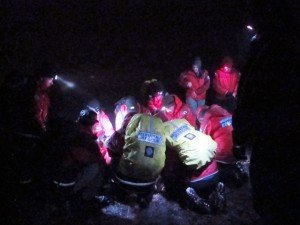
Why Search and Rescue Lighting Is a Distinct Category
General outdoor or industrial lighting does not automatically translate well to search and rescue use. A few factors make this application genuinely different.
Duration is unpredictable. A search may last an hour or continue through an entire night. Equipment needs to perform reliably across durations that cannot be planned for in advance, which puts real weight on genuine runtime rather than optimistic manufacturer figures.
Terrain and conditions vary constantly. A single search operation might move from open moorland to dense woodland to a flooded area to a confined structure within the same deployment. Lighting needs to adapt to each of these environments without requiring a full equipment change.
Hands need to stay free. Searching, navigating rough ground, carrying equipment, and assisting a casualty all require both hands. Personal lighting that does not free the hands is a genuine limitation in this context, not just an inconvenience.
Team coordination matters. Search teams often work in formation, sweeping ground systematically or maintaining visual contact across a search line. Lighting that supports this coordination, rather than creating glare between team members, has real practical value.
Reliability cannot be compromised. Equipment failure during a search operation is not simply an inconvenience. It can genuinely affect the outcome for the person being searched for, and the safety of the team conducting the search.
Head Torches: The Core Personal Lighting Tool
For search and rescue personnel, a head torch is typically the single most important piece of lighting equipment they carry, because it keeps both hands completely free throughout a deployment.
Wide beam for terrain awareness. Moving across uneven ground, through woodland, or along a search line benefits enormously from peripheral illumination that shows what is underfoot and to the sides, not just what is directly ahead. This reduces trip and fall risk significantly during extended night operations. The HL1300W delivers strong wide beam output suited to exactly this kind of sustained outdoor movement.
Flood beam for close casualty care. Once a casualty is located, close, even illumination becomes far more valuable than a narrow spot beam. Assessing injuries, administering first aid, and preparing a casualty for extraction all benefit from shadow free, glare free lighting at close range. The HL600F provides this flood configuration, useful the moment hands on casualty care begins.
Extended runtime for long deployments. Search operations that run through a full night place real demands on battery life. A powerbelt configuration, which moves the battery pack away from the head to a body worn position, both reduces fatigue over a long deployment and allows for significantly greater runtime than a head mounted battery alone can provide. The HL3XF-L is built for exactly this kind of extended, high output use.
Browse the full Samalite head torch range to compare options suited to different search and rescue roles within a team.
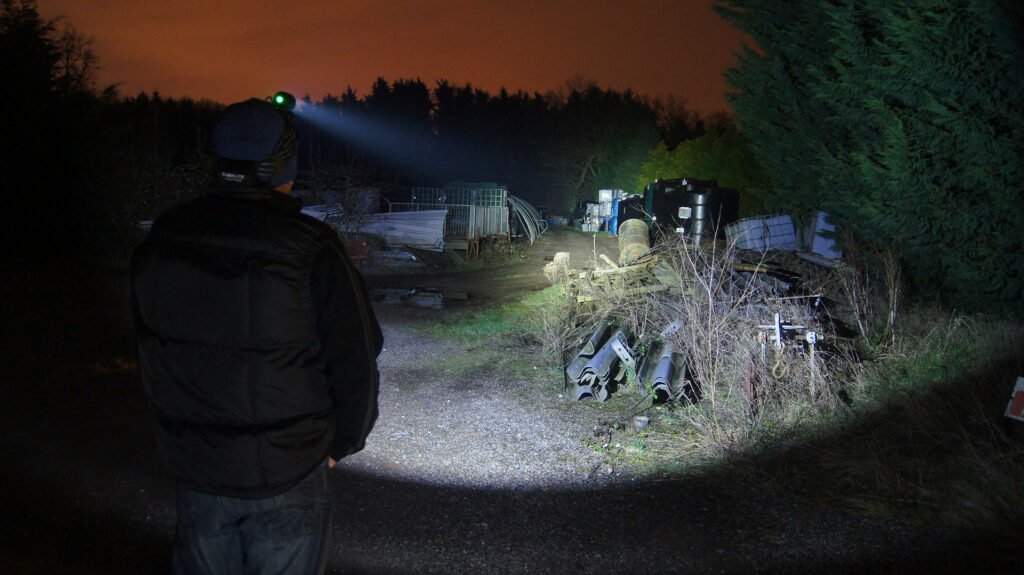
Searchlights: Covering Ground and Assessing Scale
Where a head torch supports close work and personal movement, a searchlight extends visibility across distance, which is invaluable at the outset of a search operation and throughout its duration.
Initial scene and area assessment. Arriving at a search area in darkness, a powerful handheld searchlight allows a team to quickly assess the scale and layout of the ground before committing to a search pattern, identifying obvious hazards, access points, and areas of particular concern.
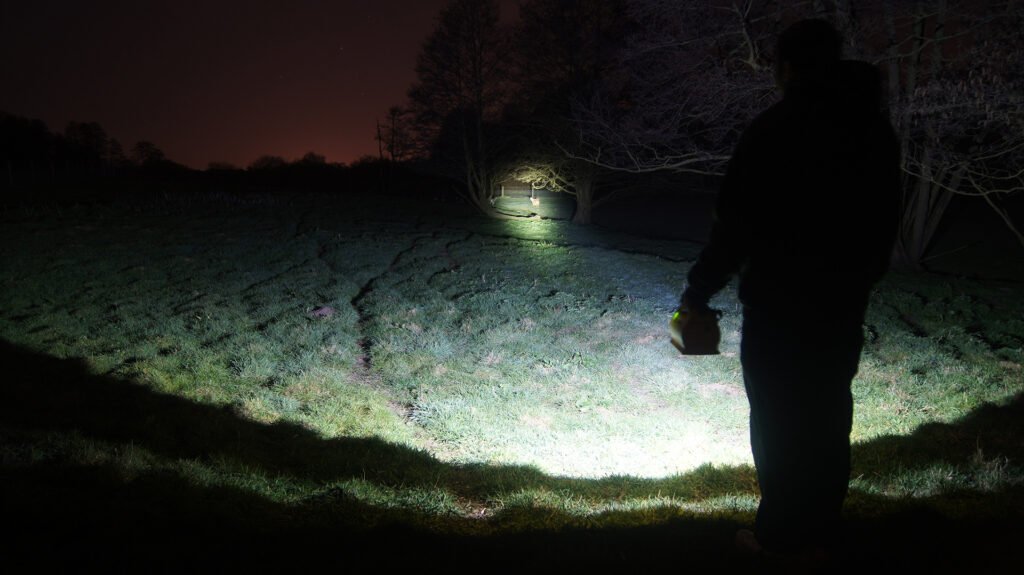
Long range sweeping across open terrain. In open countryside, moorland, or coastal search operations, a searchlight allows a small number of personnel to cover significant ground by sweeping a wide area from a fixed vantage point, rather than requiring the entire team to walk every metre on foot.
Water and reflective surface searches. For searches involving rivers, lakes, or coastal water, a focused searchlight beam cuts through surface reflection far more effectively than a dispersed flood light, making it considerably easier to identify something on or near the water surface at distance.
Signalling and communication. Beyond illumination, a powerful searchlight can serve a secondary role in signalling position to other team members, support vehicles, or aircraft during a coordinated search.
The Samalite searchlight range is built for genuinely demanding portable use, offering the beam distance and reliability that search and rescue operations require when covering open ground at night.
Portable Floodlights: Scene Lighting and Casualty Extraction
Once a search concludes, whether through locating a missing person or establishing an incident scene, broader area lighting becomes essential for the practical work that follows.
Casualty extraction points. Wherever a casualty is being prepared for evacuation, whether by stretcher, vehicle, or air ambulance, the immediate area needs solid, even illumination for the medical and extraction team to work safely and effectively.
Command and coordination points. Search operations of any scale typically establish a forward command point where team leaders coordinate the operation. Reliable area lighting here supports map work, radio communication, and general coordination throughout the deployment.
Vehicle and access route lighting. Illuminating access routes for support vehicles, and the areas around them, reduces risk during what is often a chaotic and time pressured phase of an operation.
For rapid deployment scene lighting, the Eco-Flood range provides portable, quickly deployed illumination suited to search and rescue vehicles and response kits. Where larger area coverage is needed, such as at a command point or extended extraction site, the area lighting range on telescopic masts delivers higher output from fewer units. For teams needing the lightest possible carry weight across long approach distances on foot, the Ultralight range reduces the burden without significantly compromising output.
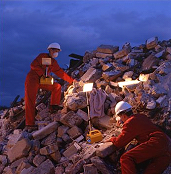
Why Rechargeable Battery Power Suits Search and Rescue Specifically
Generator powered lighting has almost no place in search and rescue operations, and the reasons go beyond general convenience.
Silence supports the search itself. Many search operations rely partly on listening, whether for a response call, movement, or environmental cues. Generator noise actively works against this, and is one of the clearest reasons rechargeable battery lighting has become standard across the sector.
No fuel logistics during a deployment. A search operation is not the time to be managing fuel supply for lighting equipment. Rechargeable units are ready to deploy the moment they leave the vehicle, with no setup sequence and nothing to run out mid search beyond the battery itself.
Safe for confined space and water adjacent searches. Collapsed structures, culverts, drainage systems, and water adjacent environments all rule out combustion powered lighting on safety grounds. Battery powered LED lighting produces no emissions and carries no equivalent risk.
Genuinely portable across difficult terrain. Search and rescue frequently means covering ground on foot across terrain unsuitable for vehicles or generators altogether. Lightweight rechargeable equipment goes wherever the team goes, without exception.
Powering Equipment During Extended Operations
For operations extending well beyond a single charge cycle, particularly multi day searches or extended incident responses, having a genuine plan for maintaining powered equipment matters.
The HD200 power and lighting range combines a substantial rechargeable power source with integrated LED lighting, useful at forward command points or vehicle staging areas where both ongoing lighting and a power source for radios, medical equipment, or charging other units may be needed simultaneously.
For search teams, establishing a rotation of charged spare units, alongside a clear point where depleted equipment is swapped and returned for charging, keeps the operation running without individual team members needing to manage charging logistics themselves during an active deployment.
Warning and Scene Marking Lighting
Alongside search and casualty lighting, clearly marking a scene, hazard, or access route is often a necessary part of a search and rescue operation, particularly where the incident involves road access, water hazards, or public areas.
Rechargeable hazard warning lights provide visible, battery powered marking that deploys in seconds without requiring any power connection. The Magnaflash kits offer this kind of rapid, visible scene marking, suited to roadside incidents, water hazard marking, and general scene demarcation during a search and rescue response.
Building a Search and Rescue Lighting Kit
A well equipped search and rescue team typically carries a combination of personal and scene lighting rather than relying on a single equipment type.
Personal kit per team member:
- One rechargeable head torch, ideally with both wide and flood beam capability or an interchangeable configuration
- Spare charged battery or powerbelt pack for extended deployments
Team level equipment:
- One or more portable searchlights for area assessment and open ground sweeping
- Portable floodlights for casualty extraction points and command locations
- Hazard warning lights for scene marking where required
- A power and lighting unit, such as the HD200 range, at vehicle staging or command points for extended operations
Standardising equipment across the team, particularly around a common charging format such as USB-C, simplifies logistics considerably and ensures any team member can use any charged unit without compatibility concerns during a live operation.
Frequently Asked Questions
Search and rescue teams typically combine three categories of lighting. Rechargeable head torches provide hands free personal illumination for movement and casualty care. Portable searchlights extend visibility across open ground for area assessment and sweeping searches. Portable floodlights provide broader area lighting for casualty extraction points and command locations. Rechargeable hazard lights are also commonly carried for scene marking.
Battery powered lighting offers several advantages specific to search and rescue work. It operates silently, which supports operations that rely partly on listening for a response. It requires no fuel logistics during a deployment and is ready to use immediately. It produces no emissions, making it safe for confined space searches. It is also significantly lighter and more portable across difficult terrain that vehicles and generators cannot access.
The right configuration depends on the role within the team. A wide beam torch such as the HL1300W suits general movement and terrain navigation. A flood beam configuration such as the HL600F suits close casualty care once a person has been located. For extended overnight deployments, a powerbelt configuration such as the HL3XF-L provides the runtime that long operations require.
Search operations are unpredictable in duration and can run through an entire night or longer. Equipment should be specified for genuine extended runtime at working brightness, not just maximum quoted figures at minimum output. Carrying spare charged batteries or units, and having a clear team level charging rotation for multi day operations, is standard practice for well prepared teams.
Yes. A focused searchlight beam is generally more effective than a dispersed floodlight for water searches, because it cuts through surface reflection more effectively and concentrates intensity on the area being examined. This makes searchlights a valuable tool for river, lake, and coastal search operations conducted from the shore or a vessel.
A searchlight projects a concentrated beam over long distances, suited to sweeping open ground, assessing scale at the start of an operation, and searching water surfaces. A floodlight spreads light broadly across a nearby area, suited to casualty extraction points, command locations, and general scene lighting once a search has concluded. Well equipped teams typically carry both, since each serves a different phase of an operation.
Most search and rescue operations take place in open terrain, structures, or water environments that do not involve classified explosive atmospheres, so standard rechargeable lighting is generally appropriate. However, for operations in specific industrial, petrochemical, or similar hazardous environments, zone appropriate ATEX certified equipment would be required, and this should be confirmed against the specific environment of any such deployment before equipment is selected.