
Most grassroots and amateur football clubs do not have permanent floodlighting. Planning permission, installation cost, and ongoing electricity supply make fixed floodlight towers unrealistic for the vast majority of clubs training and playing on council pitches, school grounds, and community sports fields.
Portable rechargeable LED floodlights have become the practical answer for these clubs. No planning application, no groundworks, no fixed infrastructure. Set up before a training session, take down afterwards, and the pitch is left exactly as it was found.
This guide covers what to look for in portable football floodlights specifically, how to set them up for different pitch sizes, and how they compare to the alternatives clubs typically consider.
Why Portable Floodlights Suit Football Grounds
Football training and matches at grassroots and amateur level run through the darkest months of the year. The season starts in August and runs through to May, meaning the majority of midweek training sessions from October onwards take place after dark.
Fixed floodlight installation is simply not viable for most clubs. Beyond the capital cost, many grounds are on shared or council owned land where permanent structures are not permitted, or the pitch itself moves slightly season to season as ground conditions are managed.
Portable rechargeable LED sports lighting solves this cleanly. It requires no permission for a temporary, non fixed installation, no electrical infrastructure, and no ongoing supply cost beyond the electricity used to charge the units between sessions. For a club running two or three evening sessions a week across a winter season, this is a genuinely practical solution rather than a compromise.
How Much Light Does a Football Pitch Actually Need?
The instinct is often to buy the single highest output light available and position it at one end of the pitch. This does not work. A single powerful floodlight illuminates the area directly in front of it and leaves the rest of the pitch in shadow.
Even coverage across the playing area matters more than raw output from one point. Multiple lights positioned around the perimeter of the pitch, each providing solid but not extreme output, deliver far better usable light for players than one very bright unit at a single corner.
General guidance for football training and small sided pitches:
| Pitch Size | Recommended Units | Output per Unit |
|---|---|---|
| Small sided training area (5v5 to 7v7) | 2 to 4 units | 1000 to 2000 lumens |
| Full training pitch, no spectators | 4 units | 2000 to 4000 lumens |
| Full training pitch with wider coverage | 6 units | 2000 to 4000 lumens |
| Competitive match standard | Permanent installation recommended | N/A |
These figures reflect training and recreational use, where the goal is safe, workable visibility for coaching and practice. Competition standard illumination for officiated matches at a higher level requires permanent, professionally designed lighting systems, but for the overwhelming majority of grassroots and amateur training use, portable units cover the requirement comfortably.
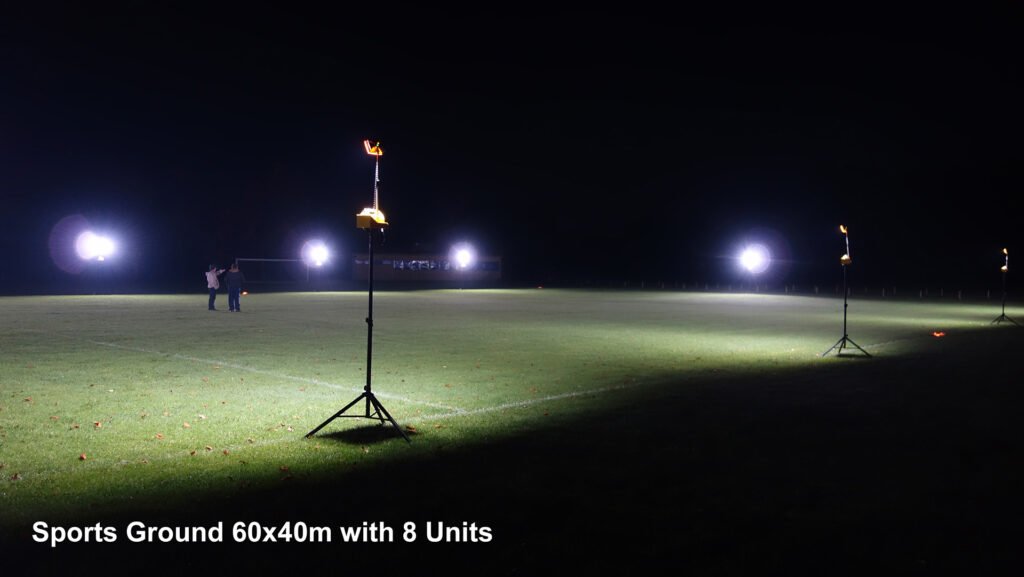
Positioning Floodlights Around a Football Pitch
Where the lights go matters as much as how many you use. A few practical principles make a real difference to usable coverage.
Position units outside the playing area. Lights and their stands should sit outside the touchline and goal lines, never on the pitch itself, both to avoid creating an obstacle and to keep the playing surface clear.
Corner positioning for full pitch coverage. Four units at the four corners of the pitch, angled inward, typically gives the most even spread across the full playing area without any single zone left significantly darker than the rest.
Elevate where possible. Mounting lights on a stand at two to three metres rather than resting at ground level significantly reduces the long shadows players cast across the pitch as they move, which is one of the more disorientating effects of poorly positioned sports lighting.
Angle to avoid glare toward players and goalkeepers. Beams angled steeply downward and inward reduce the chance of a player looking directly into a light source, which is a particular concern for goalkeepers facing across the pitch toward an opposite corner unit.
Check stability on the actual playing surface. Grass pitches are rarely perfectly level. Confirm tripod stability at each position before leaving lights unattended for the duration of a session, particularly in exposed or windy locations.
LED Sports Lighting: What to Look For
Not every portable floodlight is well suited to sports ground use specifically. A few features matter more here than in general trade or site applications.
Wide, even beam spread. Sports lighting benefits from a broader beam angle than a typical task light, since the goal is covering an area evenly rather than focusing intensity on a single point.
Flicker free output. Fast moving play and ball tracking make flicker far more noticeable and disruptive in a sports context than in most other applications. Quality LED lighting is inherently flicker free, but this is worth confirming when comparing products.
Silent operation. Community and shared grounds are frequently close to residential housing. Silent battery powered lighting avoids the noise complaints that generator powered alternatives commonly generate on shared sites.
Weather resistance for genuinely outdoor use. Training does not stop for light rain, and equipment left out for a full session needs to handle whatever the evening throws at it. An IP65 rating covers the conditions most clubs will actually encounter.
Runtime for a full session, ideally with margin for two sessions back to back. Training sessions typically run 60 to 90 minutes. A unit offering 4 to 6 hours of runtime at working output comfortably covers a single session with charge to spare, or back to back junior and adult sessions on the same evening.
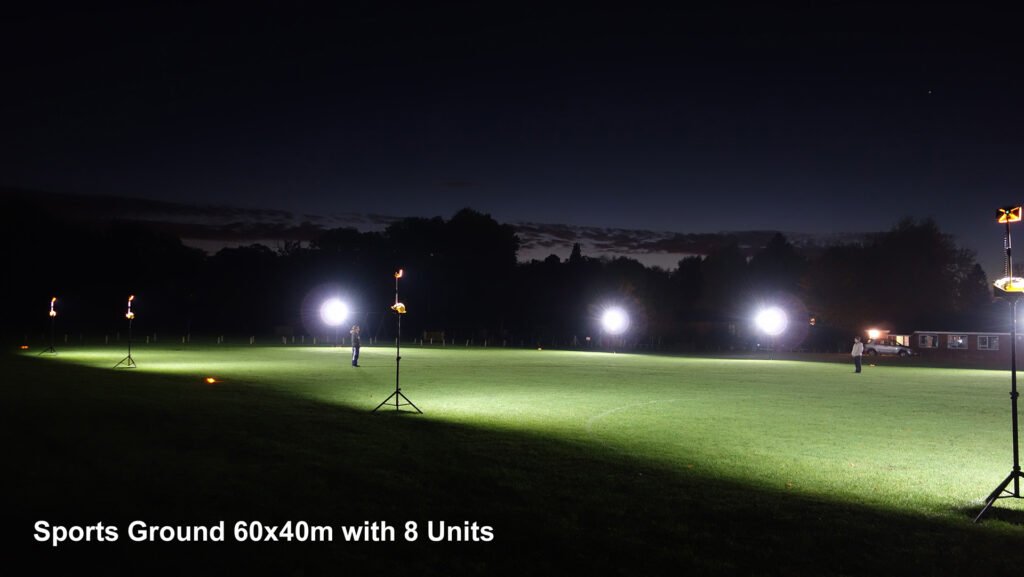
Portable Floodlights vs Generator Hire for Sports Clubs
Generator hire is the traditional fallback for clubs without fixed floodlighting, but the ongoing cost and practical downsides add up quickly across a season.
| Factor | Generator Hire | Portable Rechargeable Floodlights |
|---|---|---|
| Cost per session | Hire fee plus fuel | Minimal, electricity for charging only |
| Setup time | 15 to 30 minutes | Under 5 minutes |
| Noise | Noticeable, can trigger complaints | Silent |
| Cables across the pitch | Yes, trip hazard | None |
| Ownership after the season | Nothing retained | Equipment retained by the club |
| Availability | Requires booking in advance | Ready whenever needed |
For a club running regular winter training, the cost of ownership typically becomes more favourable than ongoing hire within a season or two, and the equipment remains available on demand rather than requiring advance booking every time it is needed.
Building a Lighting Kit for Your Club
For a small grassroots or junior club running occasional evening sessions, a starting kit of two to four compact portable floodlights covers a training area without a significant upfront investment. The Ultralight range suits this scale well, being lightweight enough for volunteers or coaches to carry and set up without difficulty before a session.
For a club running regular full pitch sessions, four to six units positioned around the pitch perimeter gives consistent, even coverage across a full training pitch. The Eco-Flood range is built for this kind of outdoor sports and training application, with the output and beam spread suited to pitch side use.
For larger grounds or multi-pitch facilities covering several training areas across a single evening, the area lighting range provides higher output units on telescopic masts, allowing fewer units to cover larger combined areas efficiently.
Browse the full Samalite floodlights range to compare specifications across the Eco-Flood, Ultralight, and area lighting options for sports ground use.
Practical Tips for Club Volunteers and Coaches
Charge on a set schedule, not just when convenient. Building charging into a fixed weekly routine, such as putting units on charge every Sunday evening ready for the week ahead, avoids the frustration of arriving at a session with a depleted unit.
Assign responsibility clearly. For clubs relying on volunteers, having one named person responsible for equipment charging and storage each week prevents the gap that occurs when everyone assumes someone else has handled it.
Store dry and secure. Between sessions, equipment should be stored somewhere dry, ideally lockable, to protect the investment and keep units ready for the next use without unexpected faults from damp storage conditions.
Do a quick pre-session check. A brief look at charge level and a visual check of the unit before setting out for a session prevents discovering a problem only after arriving pitch side in the dark.
Frequently Asked Questions
For most grassroots and amateur football clubs, a set of four to six portable rechargeable LED floodlights positioned around the pitch perimeter provides the most even and usable coverage. The Eco-Flood range is specifically suited to outdoor sports and training use, while the Ultralight range suits smaller clubs or training areas where portability and ease of setup are the priority.
Four units positioned at the corners of the pitch, angled inward, typically provide workable coverage for a full training pitch. For more even illumination across the whole playing area, six units gives additional coverage and reduces shadow gaps, particularly useful for larger pitches or sessions involving full sided games.
For training, coaching, and recreational or small sided games, yes, portable rechargeable floodlights provide adequate illumination. For officiated competitive matches at a higher standard, permanent, professionally installed floodlighting systems are typically required to meet the lighting standards specified by football governing bodies for match play.
Yes. Because portable rechargeable floodlights require no fixed installation, no groundworks, and no permanent infrastructure, they are generally well suited to council owned, school, or shared community pitches where permanent floodlight towers would require planning permission and are often simply not permitted.
Most professional units designed for sports use offer 4 to 6 hours of runtime at working output, sufficient for a standard training session with charge to spare, or for back to back sessions on the same evening. Always check runtime at the brightness level you will actually use, since maximum quoted runtime figures are often based on the lowest output setting.
Rechargeable battery powered floodlights operate silently, which is a significant advantage over generator powered alternatives on grounds near residential housing. Generator noise is one of the most common sources of complaint for clubs using temporary lighting on shared or urban sites, and battery powered units remove this issue entirely.
For clubs training regularly through a winter season, purchasing portable rechargeable floodlights typically becomes more cost effective than ongoing generator hire within one to two seasons, once hire fees and fuel costs are factored in. Beyond the cost comparison, owned equipment is also available on demand without needing to book hire in advance for every session.