
Most outdoor sports facilities do not have floodlighting infrastructure. A grass football pitch used by an amateur club. An equestrian arena that needs to run evening sessions through winter. A training ground where a single mains supply point is nowhere near the area being used that night.
For these situations, portable rechargeable floodlights have become the practical answer. No generator hire. No cable runs across a pitch. No noise. Set up in minutes, run a full training session, pack away and go.
This guide covers what to look for in portable LED sports floodlights, what output you actually need for different sporting applications, and how the Samalite Eco-Flood Sport is built specifically for this use case.
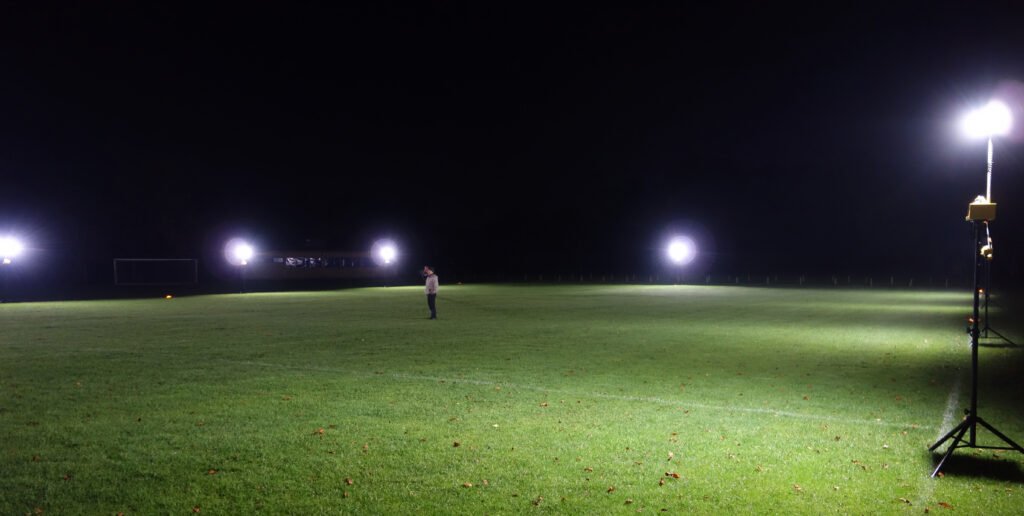
Why Mains and Generator Lighting Fails Most Amateur Sports Facilities
Permanent floodlighting is a significant infrastructure investment. For professional facilities and larger clubs, it makes sense. For the majority of amateur football pitches, training grounds, and equestrian arenas across the UK, it is simply not viable.
Generator hire fills part of the gap – but it comes with its own problems. Fuel costs add up quickly across a winter season. Noise is a genuine issue near residential areas or in rural settings where sound carries. Setup takes time away from the session itself. And trailing cables across a sports surface create a trip hazard that has no place on a pitch with players or horses.
Portable rechargeable LED floodlights remove all of those problems. Charge at home or at the clubhouse. Carry to the pitch. Position and switch on. When the session ends, pack up and leave the pitch exactly as you found it.
How Much Light Do You Actually Need?
This is the question most people get wrong. The instinct is to go for the highest lumen figure available. In practice, what matters is how that light is spread across the area you need to illuminate.
A single high-lumen floodlight pointed at one end of a pitch does not illuminate the other end. Multiple lower-output lights positioned around the perimeter of the playing area will outperform a single powerful unit at the centre every time.
General lumen guidance for portable sports lighting:
| Application | Recommended Setup | Output per Unit |
|---|---|---|
| Small training area (half pitch or less) | 2 to 4 units | 1000 to 2000 lumens |
| Full football training pitch | 4 to 6 units | 2000 to 4000 lumens |
| Equestrian arena (20x40m) | 4 units | 2000 to 4000 lumens |
| Equestrian arena (20x60m) | 6 units | 2000 to 4000 lumens |
| Match or competition standard | Permanent installation recommended | N/A |
These figures are for training and recreational use – adequate visibility, safe conditions, usable for coaching and practice. Match-grade illumination at competitive standard requires permanent infrastructure. Portable floodlights cover everything below that level, which is the vast majority of amateur and semi-professional use.
Football Training Pitches: What Works
Amateur and semi-professional football clubs running evening training through autumn and winter face the longest lighting season. Sessions start at dusk from September onwards and run in full darkness through December and January.
For a standard grass training pitch used by youth or adult amateur teams, four portable rechargeable floodlights positioned at the corners of the playing area provides workable coverage. Tripod height matters – lights mounted at 1.5 to 2 metres create shadows from players moving across the beam. Where possible, elevate to 3 metres or above for more even distribution.
Compact portable sports floodlights that mount on adjustable tripod stands solve this directly. The Eco-Flood Sport is built with exactly this application in mind – a purpose-designed rechargeable LED sports floodlight with the output, beam spread, and mounting flexibility that football training environments require.
Key practical considerations for pitch use:
- Position lights outside the playing area to avoid creating obstacles
- Angle beams inward and slightly downward to minimise glare into players’ eyes
- Avoid positioning where light shines directly toward goalkeepers facing play
- On sloped or uneven ground, check tripod stability before leaving lights unattended
Equestrian Arenas: Specific Requirements
Equestrian use places particular demands on portable arena lighting. Horses are sensitive to sudden changes in light and to visible flicker. Lighting that causes a horse to spook creates a safety risk that goes beyond inconvenience.
LED floodlights at quality-built are inherently flicker-free. The solid-state light source does not cycle in the way that older fluorescent or halogen alternatives do. For equestrian use, this is the first thing to verify – and quality rechargeable LED sports floodlights meet this requirement reliably.
Even coverage matters more in an arena than on a pitch. A horse working in dressage or jumping needs to move across consistent light conditions without hitting patches of shadow that appear as ground-level obstacles. This means more lights at lower output, positioned to eliminate gaps, rather than fewer high-output units creating contrast.
For a standard 20x40m arena, four units positioned at the midpoints of each long side and the two short ends provide the most even distribution. A 20x60m arena benefits from six units. In both cases, the same principle applies: consistent, diffuse coverage beats concentrated brightness.
The silent operation of rechargeable battery floodlights is a genuine advantage in equestrian environments. Generator noise is a real stressor for horses, particularly during early sessions when the animal is not yet warmed up. Rechargeable sports floodlights run silently.
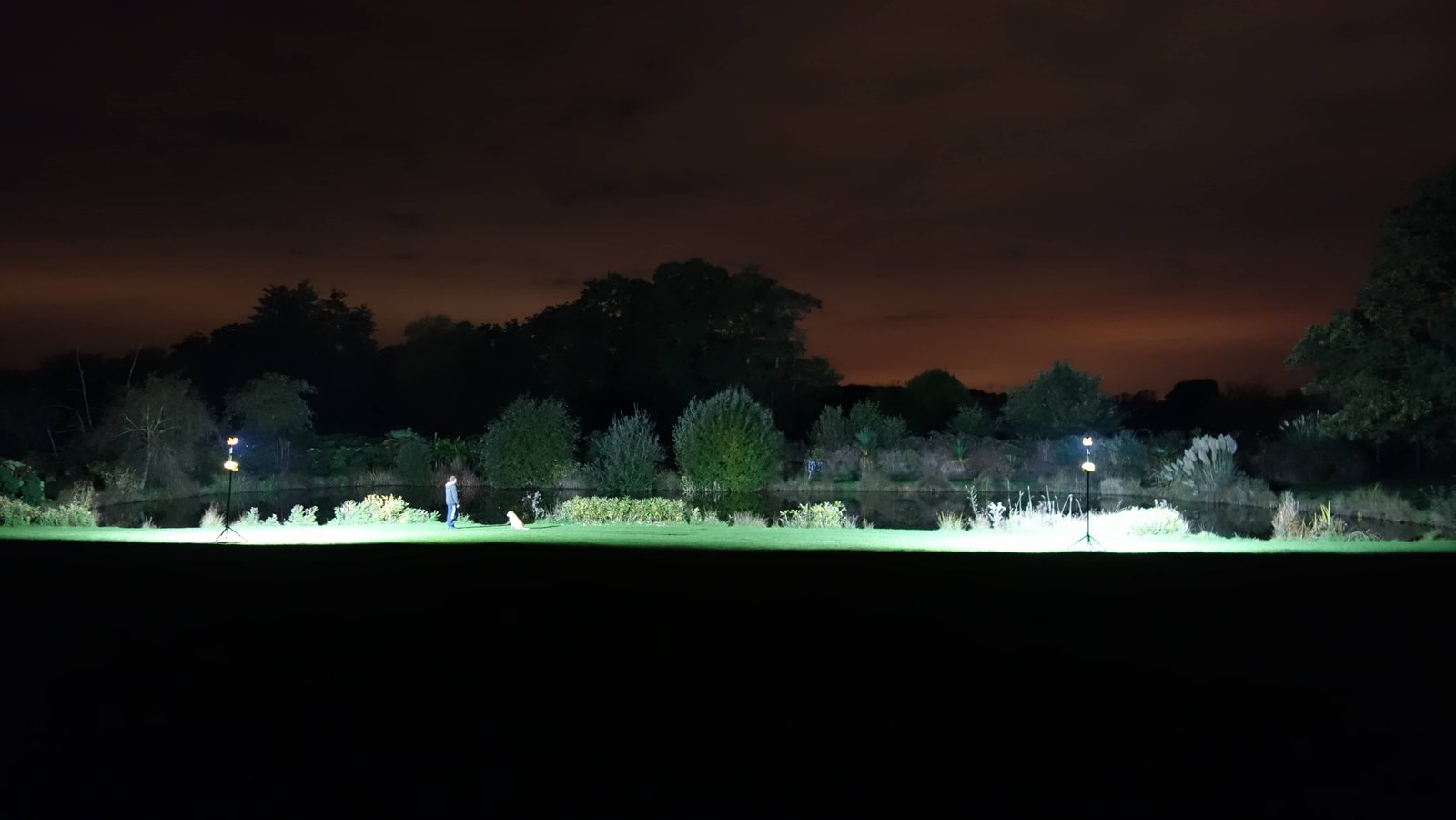
Outdoor Training Environments Beyond the Pitch
Portable rechargeable LED sports floodlights are not limited to football or equestrianism. Any outdoor training environment that lacks fixed lighting infrastructure benefits from the same solution.
Rugby and multi-use sports grounds. Training sessions on unlighted pitches. The same setup principle applies – multiple units around the perimeter, elevated for even coverage.
Athletics tracks and field event areas. Evening training for throws, jumps, and track work where the facility lighting does not cover the full site.
Cricket nets. End-of-season and winter net sessions where the pavilion power supply does not extend to the net area.
Outdoor fitness and boot camp spaces. Early-morning and evening sessions in parks or outdoor facilities where mains power is not accessible.
Motorsport and show jumping facilities. Event preparation, schooling evenings, and night-time access for competitors at venues where infrastructure lighting is limited.
In every case, the operational model is the same. Charge between sessions. Deploy in minutes. Collect at the end. No installation, no infrastructure cost, no ongoing fuel expense.
Runtime Calculations for Evening Training Sessions
Most amateur sports training sessions run 90 minutes to two hours. A rechargeable sports floodlight with 4 to 6 hours of runtime at working output covers two or three full sessions on a single charge, comfortably.
Where sessions run longer, or where a facility is used for multiple sessions on the same evening – junior training followed by adult sessions, for example – runtime needs to be calculated against total use time rather than a single session.
Practical runtime planning for sports use:
- Always check runtime specifications at the output level you will use, not maximum quoted runtime at minimum brightness
- Cold winter temperatures reduce lithium-ion battery capacity. Build in a margin for outdoor use from November through February
- Charge after every session regardless of remaining battery level. Consistent charging discipline extends cell life and ensures maximum available runtime at the next session
- If sessions run close to runtime limits, carry a spare charged unit rather than reducing output to extend battery life
The Eco-Flood Sport and the wider Samalite Eco-Flood range are designed to deliver shift-length runtime at professional output levels – the same standard required for industrial site work applies directly to extended sports use.
Rechargeable vs Generator Hire: The Real Cost Comparison
For clubs and facilities considering generator hire as the alternative, a direct cost comparison across a winter season is instructive.
| Cost Factor | Generator Hire | Rechargeable Floodlights |
|---|---|---|
| Per-session cost | Hire fee plus fuel | Electricity for charging (minimal) |
| Setup time | 15 to 30 minutes | Under 5 minutes |
| Noise | Significant | Silent |
| Cable management | Required | None |
| Trip hazard on pitch | Yes | No |
| Ownership after season | Nothing | Full equipment retained |
| Multi-season value | Ongoing hire cost | One-time purchase |
For clubs running two or three sessions per week across a 25-week winter season, the cost case for ownership versus hire becomes straightforward within the first or second season. The equipment is retained, the hire cost disappears, and sessions can be arranged without booking a generator in advance.
The Eco-Flood Sport: Built for Outdoor Sports Applications
The Eco-Flood Sport is Samalite’s purpose-designed portable rechargeable LED sports floodlight. It is built around the specific requirements of outdoor sports environments – the output to illuminate a training area properly, the runtime to cover a full evening of use, and the portability to be carried to a pitch by one person without specialist equipment.
Key features relevant to sports and equine use:
- High-output LED with wide beam spread designed for area coverage
- Rechargeable lithium-ion battery with runtime suited to extended sessions
- Tripod-compatible mounting for elevated positioning
- IP-rated for outdoor exposure to typical UK weather
- Silent operation – no generator noise in environmentally sensitive or residential-adjacent locations
- Fully portable – no mains supply or generator required
For facilities needing higher total output across a larger area, the Eco-Flood 14k6 and the ALU area lighting range provide stepped-up performance while maintaining the same portable, rechargeable format.
View the full Samalite floodlights range to compare specifications across the Eco-Flood and Ultralight series.
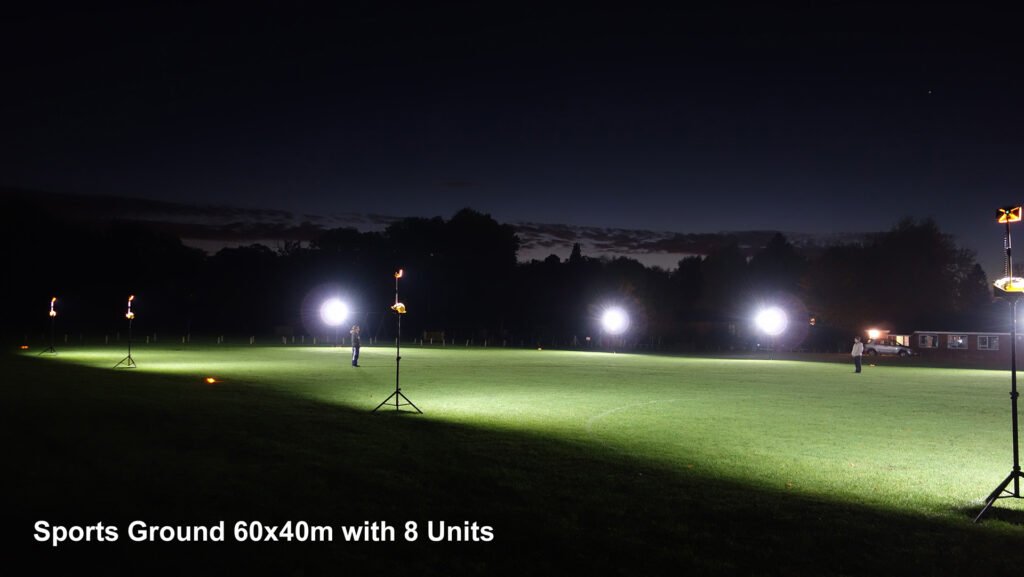
Practical Setup Guide for Sports Floodlights
Getting the most from portable sports floodlights comes down to positioning as much as output. A well-positioned lower-output unit outperforms a poorly positioned high-output one.
Step 1 – Plan positions before arriving at the pitch. For a football pitch, mark the four corners of the playing area as starting positions. For an arena, mark the midpoints of the long sides and the two short ends. Adjust based on obstacles, spectator areas, and access routes.
Step 2 – Set tripod height before angling the beam. Get the light to the height you want, then angle. Reversing this sequence makes it harder to get consistent angles across multiple units.
Step 3 – Angle inward at approximately 30 to 45 degrees from vertical. This sends most of the beam into the playing area rather than toward the horizon. Adjust by checking the coverage from the centre of the pitch.
Step 4 – Check for glare at player or rider eye level. Walk to the playing area and look toward each light. If direct beam is visible, angle the unit slightly downward or reposition. For equestrian use, check from horseback height as well as on foot.
Step 5 – Confirm tripod stability before leaving lights unattended. On grass or soft ground, tripod feet can sink or shift. A light that falls mid-session creates both a safety hazard and a disruption.
Frequently Asked Questions
Portable rechargeable sports floodlights are battery-powered LED floodlights designed for outdoor sports and training environments without mains power. They charge between sessions and deploy without cables, generators, or power infrastructure. They are used on football training pitches, equestrian arenas, rugby grounds, athletics facilities, and other outdoor training environments where permanent floodlighting is not installed.
For a standard amateur or semi-professional training pitch, four units positioned at the corners of the playing area provides workable coverage for training sessions. Larger pitches or those requiring more even illumination benefit from six units. The key principle is multiple units around the perimeter rather than one or two central units – distributed lighting eliminates the shadows that concentrated sources create.
Yes, for training and recreational use. Portable rechargeable LED sports floodlights provide sufficient illumination for coaching, skills sessions, and small-sided games. Match-grade competitive lighting at the highest standard requires permanent installed infrastructure. For the vast majority of amateur and semi-professional training use, portable rechargeable floodlights are entirely adequate.
Runtime varies by model and output level. Professional units designed for extended use typically deliver 4 to 8 hours at working output – sufficient for multiple training sessions on a single charge. Always verify runtime at the brightness level you will actually use, as maximum quoted runtime figures are typically measured at minimum brightness. Cold winter temperatures also reduce lithium-ion battery capacity, so build in a margin for outdoor winter use.
Yes. Rechargeable LED sports floodlights are well suited to equestrian arenas for several reasons. They operate silently, which avoids the generator noise that can unsettle horses. Quality LED units are inherently flicker-free, eliminating the light cycling that older lighting types produce. And the portable format allows positioning to be adjusted until even coverage is achieved without fixed installation costs.
The Eco-Flood Sport is specifically designed for sports and outdoor training environments, balancing output, beam spread, and portability for pitch and arena use. The Eco-Flood 14k6 delivers higher output and suits larger areas or applications requiring more powerful illumination. Both are portable, rechargeable, and suitable for outdoor use. See the full floodlights range for a direct specification comparison.
Portable rechargeable sports floodlights cost more upfront than a single generator hire session but eliminate the ongoing hire and fuel cost across a season. They also set up in under five minutes, run silently, require no cable management, and create no trip hazards on the playing surface. For clubs running regular sessions across a winter season, ownership pays for itself within the first or second season.