
A floodlight illuminates what’s in front of you. A searchlight reaches what’s far ahead.
That distinction matters more than most people realise when specifying portable lighting for professional use. There are situations where a powerful flood simply cannot do the job – not because of output, but because of range. A beam that spreads wide loses intensity quickly over distance. A focused searchlight beam carries that intensity much further.
This guide covers the most common professional use cases for rechargeable searchlights, and what to look for when choosing one.
What a Searchlight Actually Does
The defining characteristic of a searchlight is throw – the ability to project a concentrated beam over extended distances while maintaining enough intensity to be genuinely useful at the far end.
Where a floodlight might give you good working light out to 10 or 15 metres, a quality rechargeable searchlight can illuminate objects clearly at 100 metres or beyond. The beam stays tight rather than dispersing, which is what makes that reach possible.
For many professional applications, that range capability is the only thing that works. No amount of additional floodlights solves the problem of needing to see something that is simply too far away.
Use Case 1: Security and Perimeter Checks
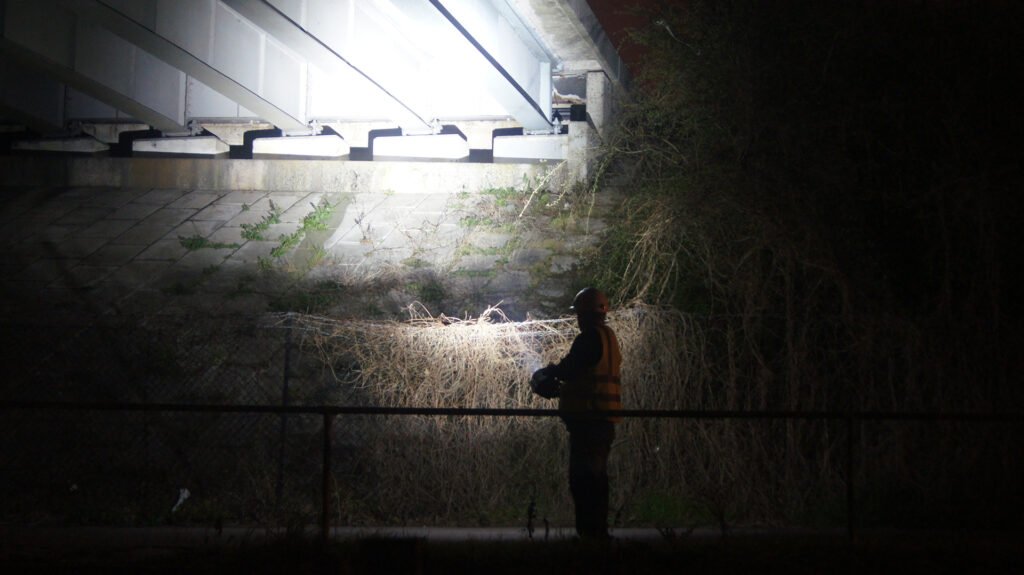
Security teams covering large sites, yards, and perimeters face a routine problem. A fixed lighting installation covers known areas. The gaps between those areas, boundary fencing at distance, and unlit corners of large sites all require a portable solution.
A handheld rechargeable searchlight lets a lone operative cover substantial ground. Sweep a beam along a fence line from a fixed position. Identify whether movement at distance is a person, an animal, or nothing of concern. Check areas of a yard without walking the full perimeter every time.
This reduces the time and physical effort involved in routine security checks while giving operatives confidence that they are actually seeing what they need to see, rather than relying on general ambient light.
For sites with vehicle access, a searchlight mounted or held from a patrol vehicle extends effective visibility across the entire site quickly.
Use Case 2: Search and Rescue Operations
The name is not a coincidence. Searchlights were developed specifically for finding things and people at distance in poor visibility conditions.
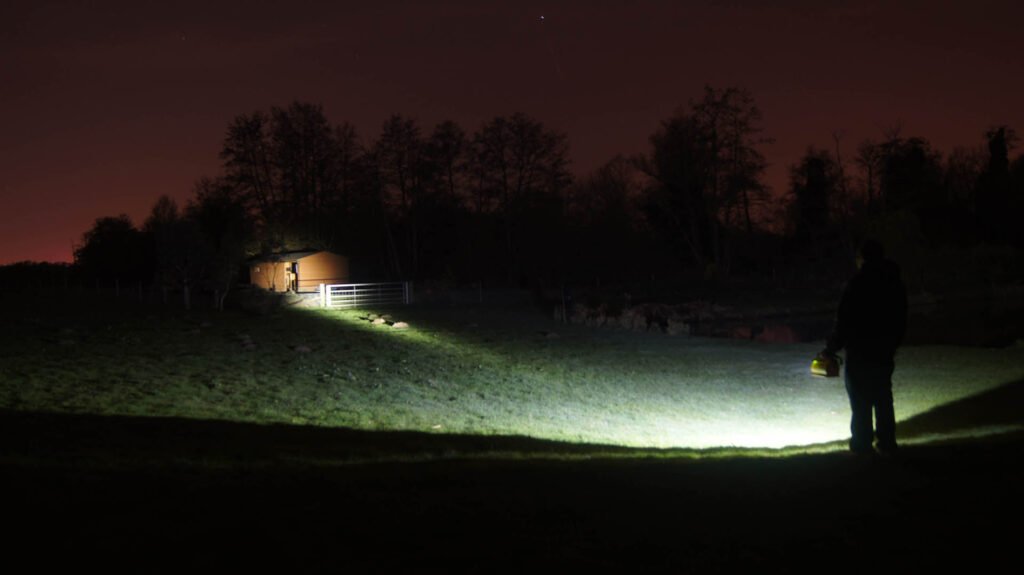
Search and rescue teams operating in open country, woodland, coastal areas, or large industrial sites need to cover ground efficiently. Walking every metre of a search area is slow. Sweeping with a high-output searchlight allows systematic coverage from fixed positions, dramatically reducing the time taken to identify a target or clear an area.
Handheld rechargeable searchlights are particularly valuable here. Teams are mobile, often on foot, and cannot rely on power infrastructure in remote locations. Battery-powered units go wherever the team goes and deploy the moment they are needed.
The SL2000Li and the SL850 series are built for exactly this kind of mobile, demanding use – substantial beam throw in a portable format that travels with the team.
Use Case 3: Marine and Waterside Operations
Water at night is a particular challenge for lighting. Reflections, mist, and the absence of any fixed reference points make navigation and safety assessment difficult.
Searchlights have a long history in marine applications for exactly this reason. A focused beam cuts through surface reflection in a way that dispersed flood lighting cannot. Identifying a marker buoy, checking a mooring at distance, or scanning the water surface for a hazard all benefit from the concentrated throw of a proper searchlight.
For inland waterways, lock operations, dock facilities, and coastal maintenance teams, a portable rechargeable searchlight gives operatives the ability to see and work effectively at distance without any fixed lighting infrastructure.
The handheld format means it works equally well from a vessel, a dock, or the bankside.
Use Case 4: Railway and Trackside Inspection
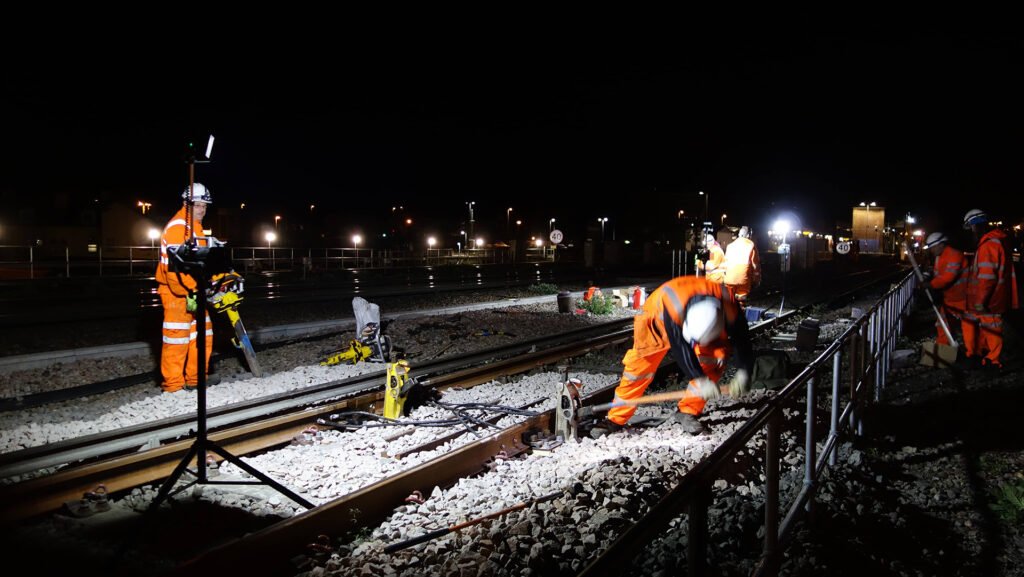
Railway environments present unique lighting requirements. Tracks run in straight lines over long distances. Hazards and obstructions need to be identified well ahead of where the team is standing. And possession windows give limited time to cover significant ground.
A searchlight allows a team to assess the track ahead before moving forward. Identify obstructions, check signal positions, and assess conditions along a section of track from a standing position. This is faster and safer than advancing into darkness and discovering problems at close range.
The zero-emission requirement for trackside work is also met by rechargeable battery searchlights. No fumes, no noise, and fast enough to deploy and clear within the constraints of a tight possession window.
Paired with portable rechargeable floodlights for close work and rechargeable head torches for hands-free individual lighting, a searchlight completes a full trackside lighting kit.
Use Case 5: Emergency Scene Assessment
When a response team arrives at an incident in darkness, the first task is understanding what they are dealing with. The extent of the problem. Whether the access route is safe. Whether there are hazards beyond the immediate scene.
A searchlight makes that initial assessment fast. Sweep the area on arrival. Establish the perimeter of the incident. Identify access and egress routes. Check for secondary hazards before committing the team.
This takes seconds with a handheld searchlight rather than minutes of cautious movement with a floodlight. In emergency response, those seconds matter.
Once the scene is assessed, portable floodlights and head torches take over for the task work itself. The searchlight has already done its job by that point.
Use Case 6: Construction and Civil Engineering
Large construction sites at night are not uniformly lit. Tower lights and mast-mounted floodlights cover primary work areas. The rest of the site – access routes between zones, boundary areas, elevated structures, and sections not currently in active use – often sits in relative darkness.
Site managers, safety officers, and night shift supervisors need to move across those sites and assess conditions in areas that fixed lighting doesn’t reach. A searchlight provides that capability without any setup or infrastructure requirement.
Civil engineering projects in particular often involve long linear work fronts – road schemes, pipeline routes, drainage works – where the ability to see along the line of work at distance has direct practical value for planning and supervision.
Use Case 7: Utilities and Infrastructure Maintenance
Utilities maintenance regularly takes teams to outdoor locations without any lighting infrastructure. Substations, water treatment sites, pumping stations, pipeline routes, and telecommunications infrastructure are spread across landscapes rather than concentrated in easily lit areas.
A rechargeable searchlight gives a maintenance team arriving at an unlit rural location the ability to assess and access the site quickly. Identify the equipment that needs attention. Check the surrounding area before working. Navigate access tracks and approach routes after dark.
Combined with portable floodlights for the actual work area, a searchlight handles everything a utilities team needs from arrival through to departure.
Spot, Flood, or Adjustable: Which Beam Type?
Professional searchlights vary in how they handle beam pattern. Understanding the difference helps match the right unit to your use case.
| Beam Type | What It Does | Best For |
|---|---|---|
| Fixed narrow spot | Maximum throw, minimum spread | Long-range search, marine, security |
| Fixed flood | Wide spread, shorter range | Scene assessment, area coverage |
| Adjustable spot to flood | Variable beam angle | Versatile professional and emergency use |
For most professional applications, adjustable beam capability offers the best flexibility. Start with a tight spot for long-range assessment, then open to flood for closer scene work. The SL850LiF offers this kind of versatility in a portable handheld format.
For maximum range with a fixed beam, the SL2000Li delivers the highest output in the Samalite searchlight range.
What to Look For When Choosing a Rechargeable Searchlight
Beam throw – how far the beam remains useful. Check manufacturer specifications and, where possible, independent assessments. Marketing figures and real-world performance can differ.
Output and runtime balance – higher output reduces runtime. Look for multiple brightness settings that let you conserve battery when full power isn’t needed.
IP rating – IP65 minimum for professional outdoor use. Protection against rain and dust is a basic requirement for any field searchlight.
Handheld vs mounted – handheld units offer mobility. Some applications benefit from the ability to mount on a vehicle or fixed position. Check whether the unit you are considering offers both options.
Weight – a searchlight carried by hand across a site or on foot through open ground needs to be manageable over the duration of the deployment. Heavier units with larger batteries deliver more runtime but at a cost in portability.
Charging – USB-C charging and compatibility with standard charging equipment reduces logistics complexity across a mixed fleet.
Browse the full Samalite searchlight range to compare specifications across the SL2000Li, SL850LiF, and SL850LiS.
Frequently Asked Questions
Rechargeable searchlights are used whenever professional teams need to project light over distances that standard floodlights cannot cover. Common applications include security and perimeter checks, search and rescue, marine and waterside operations, railway inspection, emergency scene assessment, and utilities maintenance at unlit locations. The defining advantage is beam throw – a concentrated beam that remains usable at 100 metres or beyond.
Effective range depends on output and beam focus. Professional units like the SL2000Li are capable of illuminating objects clearly at substantial distances – well beyond what any floodlight can achieve. For specific throw distances, check the technical specifications for each model, as these vary between units in the range.
Runtime varies by model and output setting. At maximum brightness, runtime is shorter. Most professional units offer multiple output levels – using a lower setting for general sweeping and reserving full power for specific long-range tasks extends total runtime significantly. Always check runtime specifications at the output level you will primarily use.
IP65 as a minimum. This provides complete dust protection and resistance to water jets from any direction, covering standard UK outdoor conditions reliably. If the unit will be used near water or in wet environments where submersion is possible, look for IP67 or higher.
No. They serve different purposes. A searchlight provides long-range directional illumination for distance visibility and scene assessment. A floodlight provides broad, even illumination for close and medium-range task work. Most professional applications need both – a searchlight for initial assessment and overview, floodlights for the work area itself.
The SL2000Li is the highest-output unit in the Samalite range, designed for maximum beam throw and long-range performance. The SL850 series includes the SL850LiF, which offers adjustable beam capability from spot to flood, and the SL850LiS. The right choice depends on whether range or beam flexibility is the priority for your application. See the full searchlight range for a direct comparison.