
When an emergency happens, lighting is not optional.
A burst water main at midnight. A fault on a railway line during a possession. A structural incident on a live industrial site. In every case, the team arriving on scene needs to be operational within seconds.
That puts specific demands on equipment. Lights that require generator setup, cable runs, or fuelling simply aren’t suitable for unplanned emergency response. The job starts the moment you arrive, and your lighting needs to as well.
What Makes Emergency Lighting Different
Planned maintenance allows time to set up. Emergency response does not.
The difference shapes everything about how lighting equipment should be specified for emergency use. Deployment speed, instant-on performance, and reliability after sitting in a vehicle for weeks between callouts are what actually matter.
A high-lumen tower light that takes fifteen minutes to fuel and position is not emergency lighting. It is a delay.
The right equipment for emergency response is:
- Immediately deployable – no setup sequence, no infrastructure required
- Fully self-contained – battery powered, no cables or fuel dependencies
- Reliable after extended storage – ready to work when called upon, not just when freshly charged
- Durable enough to survive transport in the back of a works vehicle
Outdoor Emergency Scenarios: What You’re Actually Dealing With
Emergency response in outdoor environments rarely happens in controlled conditions. Lighting equipment has to perform regardless of what it encounters.
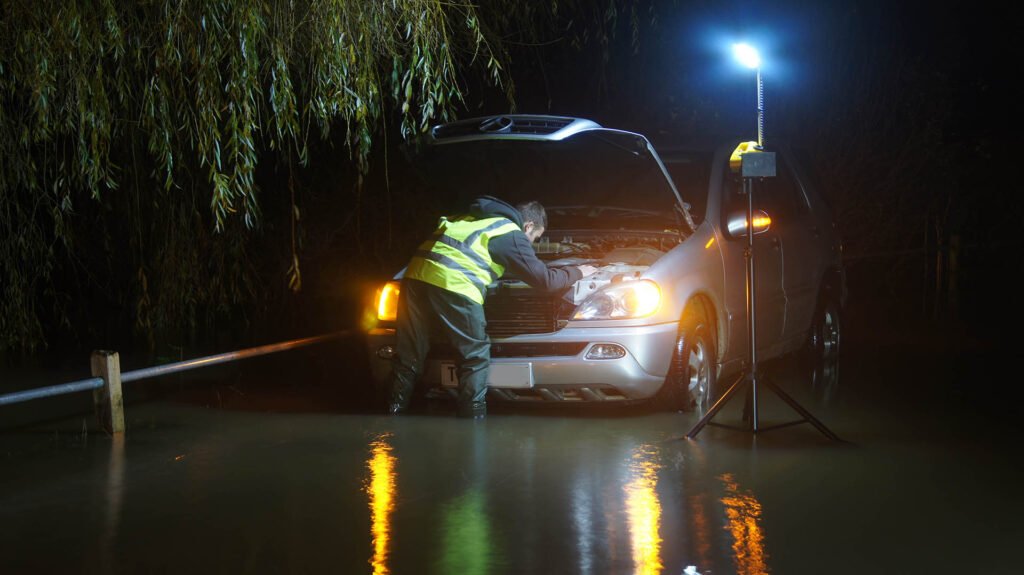
Roadside and highway incidents – works near live traffic demand both task lighting and visible warning signals. Teams need to illuminate the work area while making themselves visible to passing vehicles. These are separate requirements that need separate equipment.
Utilities and infrastructure failures – water, gas, and electrical emergency repairs happen wherever the fault is. No power supply. Often no access road. Equipment needs to travel in a standard works vehicle and deploy without any site preparation.
Railway and trackside response – tight possession windows and strict safety requirements. Lighting must deploy and clear quickly, produce no emissions near enclosed trackside infrastructure, and meet the output demands of safe working in complete darkness.
Industrial incidents – factory floors, plant rooms, substations, and process facilities all present their own access constraints. Confined areas, potential hazardous atmospheres, and the need for high-quality illumination for safe decision-making under pressure.
The Case for Rechargeable Battery Lighting in Emergency Situations
Generator-powered lighting works well when you have time to set it up. Emergency response rarely gives you that time.
Battery-powered LED lighting solves the core problems that make generators unsuitable as primary emergency equipment.
| Factor | Generator | Rechargeable Battery |
|---|---|---|
| Time to operational | 5-15 minutes | Under 30 seconds |
| Location flexibility | Limited by cable reach | Fully mobile |
| Confined space use | Not suitable (emissions) | Safe – zero emissions |
| Noise in sensitive areas | High | Silent |
| Vehicle storage | Heavy, fuel management required | Lightweight, no fuel risk |
| Readiness after storage | Requires fuel check and start | Switch on and go |
For the majority of outdoor and industrial emergency scenarios, rechargeable portable lighting is not a compromise – it is the correct choice.
Essential Equipment for Emergency Response Lighting
No single product covers every emergency scenario. Effective emergency lighting kits combine units that handle different requirements.
Portable LED floodlights handle general scene illumination. A well-positioned floodlight gives the team working light across the immediate area without anyone needing to hold a torch. Samalite’s Eco-Flood range is built for exactly this kind of deployment – robust, rechargeable, and ready to work immediately.
For larger incidents requiring more substantial coverage, the ALU area lighting units with telescopic masts deliver high-output illumination across a wider footprint from a single position.
Rechargeable head torches give individual responders hands-free, directed light that follows their line of sight. In emergency conditions where both hands are occupied (on tools, equipment, or another person) a quality head torch is essential. The HL1300W and HL3000W provide the output and runtime for demanding emergency use.
Searchlights extend visibility across distance. Assessing an incident scene on arrival, checking access routes, or illuminating perimeters in complete darkness – these tasks need reach that floodlights cannot provide. Samalite’s SL2000Li and SL850 searchlight range delivers long-range portable illumination without any power infrastructure.
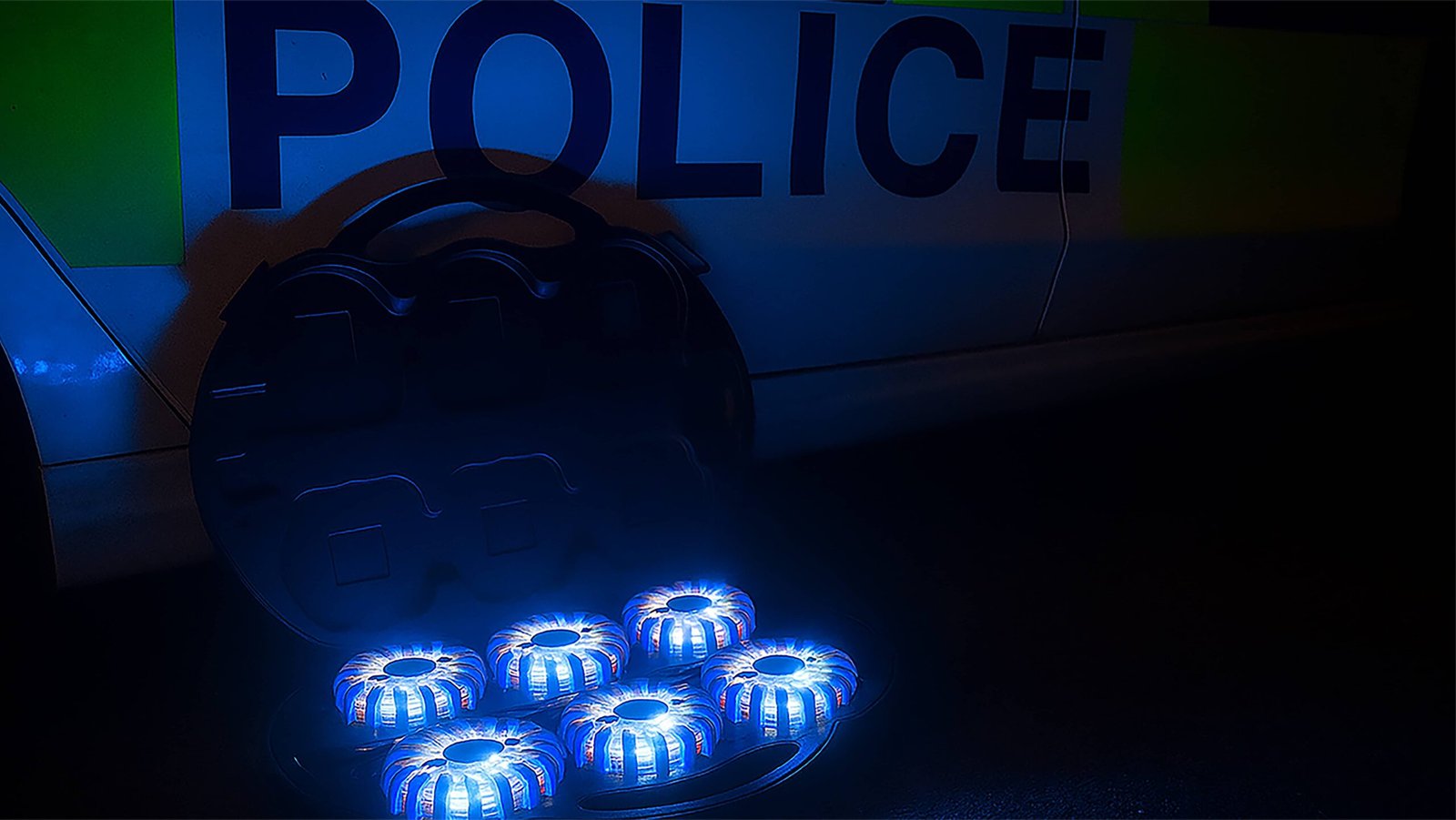
Hazard warning lights protect the team. Any emergency response near roads, pedestrian access, or public areas requires visible warning signals independent of task lighting. The Magnaflash Kit provides rechargeable LED hazard beacons that deploy in seconds and remain visible over distance.
IP Ratings, ATEX, and Why Certification Matters
Outdoor and industrial emergency environments expose equipment to conditions it has to be rated for. Buying lighting that isn’t specified for the environment is a risk that shows up at the worst possible moment.
IP65 minimum for outdoor use. This provides complete dust protection and resistance to water jets from any direction. For UK outdoor emergency response (rain, standing water, dust, debris) IP65 covers standard conditions reliably. Higher ratings apply where submersion is possible.
IP67 and IP68 for more demanding environments. Flood-damaged infrastructure, work near waterways, and scenarios where equipment may be partially submerged require correspondingly higher protection ratings.
ATEX certification for hazardous atmospheres. Petrochemical facilities, gas infrastructure, grain handling, and similar environments contain potentially explosive atmospheres. Standard lighting equipment poses an ignition risk in these locations regardless of how well it performs otherwise. ATEX-certified equipment is the only appropriate option. Non-certified equipment cannot be used in these zones.
UKCA and CE marking confirm baseline compliance with UK and EU safety requirements. These should be present on any professional lighting used in industrial environments.
Always verify that your equipment is rated for the environments your teams actually work in before an incident happens, not during one.
Fleet Readiness: The Problem Most Teams Overlook
Equipment that isn’t ready when the call comes is equipment that has failed before the job started.
Emergency lighting readiness is a fleet management discipline, not just an equipment decision. Battery-powered units need to be charged and checked between deployments. A light that has sat in a van for three weeks on a partial charge may not deliver the runtime the job requires.
Practical steps that make a difference:
Establish a return-to-charge protocol. Every unit returns to a charging station after each deployment, regardless of how much battery was used.
Track charge status across the fleet. Don’t rely on individuals to flag depleted units. Build charge checking into vehicle pre-use checks or depot handover procedures.
Size the fleet for concurrent demand. If multiple teams may respond simultaneously, each needs a complete kit. Sharing equipment between active deployments is not a workable emergency plan.
Carry backup units for extended incidents. Long-duration emergencies will exhaust a single set of batteries. Spare charged units in the vehicle remove that risk.
Building an Emergency Lighting Kit
A practical emergency lighting kit for an outdoor or industrial response team covers four things: scene illumination, personal lighting, long-range visibility, and hazard warning.
A starting point for a two-person response team:
- 2x portable rechargeable floodlights with stands
- 2x high-output rechargeable head torches (one per team member)
- 1x portable searchlight for long-range assessment
- Rechargeable hazard warning lights appropriate for the operating environment
- Charged spares or second set for extended deployments
Standardise equipment across vehicles and teams. Mixed brands and models create charging incompatibilities, complicate spare parts, and slow down training. Consistent kit means anyone can pick up any vehicle and know exactly what they have and how to use it.
Key Environmental Checklist Before Specifying Equipment
Before selecting emergency lighting for your fleet, work through the environments your teams actually respond to:
- Outdoor, exposed to weather – IP65 minimum required
- Confined spaces (tunnels, tanks, basements) – battery power mandatory, zero emissions
- Potential explosive atmospheres – ATEX certification required
- Near live traffic or public areas – hazard warning lights required alongside task lighting
- Railway or trackside environments – silent operation, fast deploy and clear times essential
- Remote locations without power – battery power removes infrastructure dependency entirely
Frequently Asked Questions
Rechargeable battery-powered LED lighting is the most appropriate choice for emergency response. It deploys instantly, requires no infrastructure, produces zero emissions for safe use in confined spaces, and operates silently. A combination of portable floodlights for scene illumination, head torches for individual responders, and a searchlight for long-range visibility covers most emergency scenarios effectively.
For emergency response use, aim for a minimum of 8 hours runtime at working output. This covers a full shift with margin for battery ageing. Units should be charged after every deployment rather than only when fully depleted, as this extends battery life and ensures maximum available runtime at the next callout.
Yes, and they should be. Battery-powered LED lighting produces no emissions at point of use, making it the only appropriate choice for confined space emergency response. Generator lighting is unsuitable in these environments due to exhaust fumes. For confined spaces with potentially explosive atmospheres, ATEX-certified equipment is required.
IP65 as a minimum for outdoor use. This provides complete dust ingress protection and resistance to water jets from any direction, covering typical UK weather conditions. For emergency response near flooding or in waterlogged environments, IP67 or IP68 ratings provide additional protection against submersion.
If your teams respond to incidents in petrochemical facilities, gas infrastructure, grain handling operations, or any environment with potentially explosive atmospheres, yes. ATEX certification is a legal and safety requirement in these zones. Standard lighting equipment cannot be used regardless of its other specifications.
Implement a clear post-deployment charging protocol: all equipment goes back to a designated charging station immediately after every deployment. Check charge status as part of vehicle pre-use inspection. Never return units to a readiness position in a depleted state. For teams with rapid turnaround requirements, fast-charging compatible units reduce the gap between deployment and full charge.
A portable floodlight illuminates the immediate work area with broad, even light – it is task and scene lighting. A searchlight projects a concentrated beam over long distances for assessing access routes, scanning large areas, or checking the perimeter of an incident scene on arrival. Both serve distinct purposes and complement each other in a complete emergency lighting kit.